Taixin Semiconductor

News detail

Differences Between Wi-Fi HaLow and Traditional Wi-Fi
2021-06-07

Wi-Fi is like the oxygen of our connected world. It is the most widely used wireless networking protocol today, carrying more than half of all Internet traffic. “Wi-Fi” is an all-encompassing term used to describe the evolving family of 802.11 protocols, which have developed for more than 20 years. The Wi-Fi Alliance is the organization driving the adoption and development of Wi-Fi, and it has used numerical nomenclature to simplify the names of common Wi-Fi generations, such as Wi-Fi 4 = 802.11n, Wi-Fi 5 = 802.11ac, and Wi-Fi 6 = 802.11ax. You are likely using one of these Wi-Fi types at home or at work.

Despite the ubiquity of Wi-Fi 4/5/6, the rapid growth of the Internet of Things (IoT) has forced a rethink of traditional Wi-Fi. This reassessment has revealed technology gaps and redefined the role that the 802.11 protocol should play in today's world of wireless connectivity for ultra-low-power IoT devices. The higher requirements of IoT and machine-to-machine (M2M) applications for long-range connectivity and low power consumption are driving demand for another type of Wi-Fi optimized for IoT.

The Wi-Fi HaLow (pronounced “HEY-low”) protocol fills these gaps by providing an ultra-low-power wireless solution that connects large numbers of IoT devices over much longer distances and with much lower power consumption than traditional Wi-Fi. The protocol was approved in 2016 by the IEEE 802.11ah Task Group and is called Wi-Fi HaLow by the Wi-Fi Alliance.

Wi-Fi HaLow is essentially a low-power, longer-range, and more versatile version of Wi-Fi operating in unlicensed sub-1-GHz spectrum. The Wi-Fi HaLow standard uniquely combines energy efficiency, long-range connectivity, low latency, high-definition video-quality data rates, security features, and native IP support, making it an ideal protocol choice for wirelessly connected, battery-powered IoT devices.

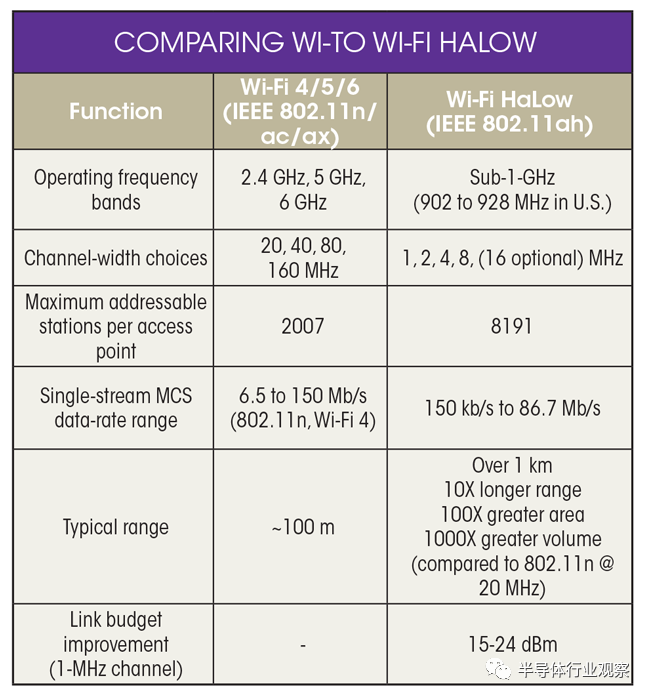
Let us take a closer look at some of the key differences between Wi-Fi HaLow and traditional Wi-Fi (see table), and why the 802.11ah protocol is well suited to meeting the connectivity requirements of IoT applications.

Battery-Friendly Protocol


Wi-Fi HaLow delivers superior energy efficiency for power-sensitive IoT devices. The various sophisticated sleep modes specified by IEEE 802.11ah enable HaLow devices to remain in extremely low-power states for extended periods, thereby conserving battery energy:

Target Wake Time (TWT):This allows a station (STA) and an access point (AP) to pre-schedule the time when a sleeping STA wakes up and listens for beacons.

Restricted Access Window (RAW): The AP can grant permission to a subset of STAs to transmit their data, while others are forced to sleep, buffer non-urgent data, or both.

Extended Maximum Basic Service Set (BSS) Idle:This extends the permitted idle time for a STA to five years.

Hierarchical Traffic Indication Map (TIM):More efficient encoding of TIM by group saves beacon broadcast time.

Short MAC Headers:This reduces header overhead, broadcast time, and power consumption, and frees up spectrum.

Null Data PHY Protocol Data Units (NPD):This embeds MAC-like ACK/NAK into the PHY layer to reduce time and power consumption.

Short Beacons:Short (limited) beacons are sent frequently to synchronize STAs, while full beacons are sent less often.

BSS Coloring:Color assignments indicate the BSS group of a specific AP, and STAs can ignore other colors.

Bidirectional TXOP (BDT) (formerly called Speed Frame): This reduces the number of medium access attempts when a STA wakes up and finds that there are uplink and downlink frames to transmit. BDT uses a response indication in the signal (SIG) field of the physical layer protocol data unit (PPDU) to increase TXOP duration protection against transmissions by third-party STAs.

The protocol's efficient sleep and power management modes support multi-year battery operation of IoT devices, along with a variety of flexible power and battery-size options, from short-range IoT devices running on coin cells to higher-power, longer-range (over 1 km) battery applications. Compared with Wi-Fi protocols in the 2.4 GHz and 5 GHz bands, the protocol's sub-GHz narrowband signals travel farther with less energy, thus transmitting more bits per unit of energy.

As a result, Wi-Fi HaLow chips require only a fraction of the power needed by traditional Wi-Fi chips. Although the higher data rates of traditional Wi-Fi enable users to stream high-definition video content using wide channels in the 2.4-, 5-, and 6-GHz bands and to quickly download large files, these Wi-Fi connections have a short effective range and quickly drain battery power. As a result, frequent charging or battery replacement is required, or ideally a connection to mains power. For these reasons, Wi-Fi HaLow is a better choice for power-constrained IoT devices that need to reach longer distances and operate on battery power for years while still delivering data throughput of several megabits per second.

Longer Range


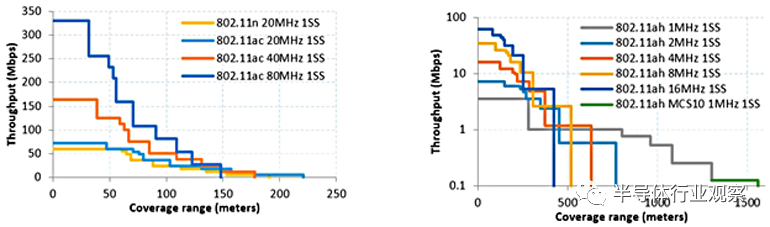
The 802.11 standard covers an exceptionally broad frequency range, from sub-GHz to millimeter wave (mmWave). HaLow is the first Wi-Fi standard to operate in unlicensed sub-GHz bands. It offers data rates ranging from hundreds of kilobits per second to tens of megabits per second, over distances ranging from tens of meters to more than one kilometer.

Compared with the narrowest 20-MHz channel used by traditional Wi-Fi, Wi-Fi HaLow's sub-1-GHz signals use narrower channels of 1 MHz and above (Figure 1). Because thermal noise in the channel is lower, this 20-fold bandwidth factor translates into a 13-dB link budget improvement. Radio frequencies between 750 and 950 MHz require an additional 8 to 9 dB of link budget compared with traditional 2.4 GHz Wi-Fi, thereby saving free-space propagation loss. In addition, the Wi-Fi HaLow protocol adds a range-optimized modulation and coding scheme (MCS10) that provides an additional 3-dB link budget boost.


In summary, compared with traditional 2.4-GHz IEEE 802.11n (Wi-Fi 4), Wi-Fi HaLow provides up to 24 dB of link budget improvement. Compared with the higher-frequency, higher-bandwidth 802.11ac (Wi-Fi 5) and 802.11ax (Wi-Fi 6/6E) protocols that use 5-GHz and 6-GHz frequencies, HaLow's link budget advantage is further enhanced. GHz spectrum with wider bandwidth.

This explains why Wi-Fi HaLow signals travel 10 times farther than traditional Wi-Fi without the need for network extenders. For example, battery-powered cameras can be placed in more convenient locations outside the walls of a home or garage. Whether the light fixtures are indoors or in an outdoor garden, the lighting system can be controlled through a single AP.

Providing end users with wireless IoT solutions that cover hundreds of meters—without additional extenders or expensive cellular data plans—is a key competitive advantage of the 802.11ah protocol. With its long-range coverage, Wi-Fi HaLow's advantages extend the range of smart home and smart city networks, enabling users to control IoT devices over 1 km away, far beyond the range of traditional Wi-Fi protocols.

Better signal penetration


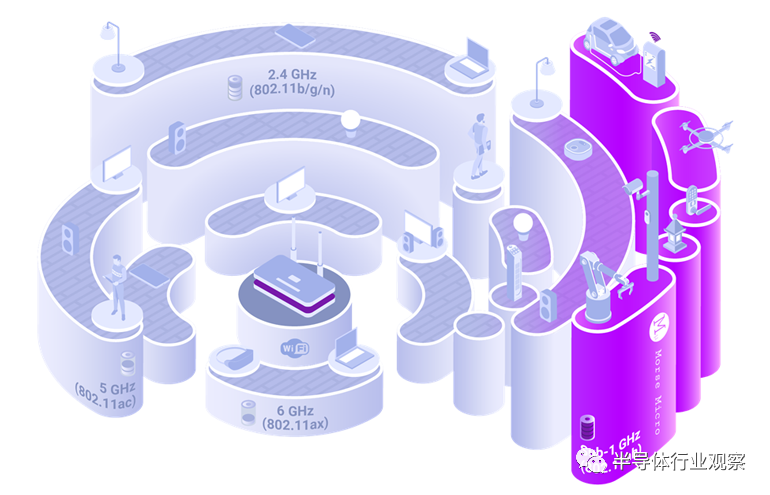
General rule: the lower the frequency, the longer the coverage and the better the penetration through obstacles. However, compared with traditional Wi-Fi, Sub-GHz Wi-Fi HaLow signals can pass through walls and other obstacles more easily.

Compared with Wi-Fi protocols in the 2.4 GHz and 5 GHz bands, variability in building materials and residential and commercial building layouts has less impact on sub-GHz HaLow signals. Wi-Fi HaLow's superior coverage through walls and buildings helps reduce customer service calls and product returns, problems that sometimes plague products using traditional Wi-Fi (Figure 2).


Wi-Fi HaLow uses orthogonal frequency-division multiplexing (OFDM) modulation to correct for reflections and multipath environments. Device manufacturers can confidently establish robust HaLow connections with an AP, regardless of whether their products are located indoors or outdoors, or in a basement or attic in a home. This flexibility eliminates the additional cost and complexity of providing proprietary hubs or bridge devices to compensate for different home architectures.

Highly scalable solution


A single Wi-Fi HaLow AP can address up to 8,191 devices, more than four times that of a traditional Wi-Fi AP. For the foreseeable future, this is enough to connect every LED light bulb, light switch, smart door lock, motorized curtain, thermostat, smoke detector, solar panel, security camera, or any imaginable smart home device.

A typical home Wi-Fi router generally supports dozens of devices. When deployed by a broadband service provider in the home, a single Wi-Fi HaLow AP can become a scalable platform for delivering additional security and utility management devices and services.

Multiple signaling options reduce the overhead required to manage and control large numbers of HaLow devices. This minimizes signal collisions and frees up radio waves for active devices to transmit more data at the fastest possible MCS rate.

Like traditional Wi-Fi, HaLow can automatically adjust bandwidth based on signal integrity and distance from the AP. Predefined MCS levels support bandwidth from 150 kb/s to 40 Mb/s for single-stream, single-antenna products using 1 to 8 MHz channel widths, and with an optional 16-MHz-wide channel.

Wi-Fi HaLow's star network topology, superior penetration, extensive coverage, and massive capacity free connectivity from difficult-to-deploy and bandwidth-constrained mesh networks, simplifying network installation and minimizing total cost of ownership.

Unlicensed spectrum with noise immunity


Like traditional Wi-Fi in the 2.4-, 5-, and 6-GHz bands, Wi-Fi HaLow enables end users to own their devices and use license-exempt sub-GHz radio spectrum ranging from 750 to 950 MHz. The available frequency range, maximum transmit power, and duty cycle for Wi-Fi HaLow vary around the world (for example, the available HaLow spectrum is 902 to 928 MHz in the Americas and 863 to 868 MHz in Europe).

Wi-Fi HaLow operates in the industrial, scientific, and medical (ISM) bands and can use multiple channel bandwidths: 1 MHz, 2 MHz, 4 MHz, 8 MHz, and 16 MHz. The narrower the bandwidth, the farther the signal can travel. Data is transmitted in packets across multiple subchannels using OFDM, which improves performance in challenging RF environments, especially in the presence of strong interference from other radio devices. Forward error correction (FEC) coding also provides additional protection for packet recovery, ensuring robust connections.

Secure and interoperable


Wi-Fi HaLow, like other IEEE 802.11 Wi-Fi versions, is an inherently secure wireless protocol. It supports the latest Wi-Fi certification (WPA3) requirements and AES encryption of over-the-air (OTA) traffic, and its data rates enable secure OTA firmware upgrades.

Like other types of Wi-Fi, HaLow is a globally recognized standard (IEEE 802.11ah) that defines how connected devices securely authenticate and communicate. Device vendors using Wi-Fi HaLow can be confident that their products and networks will interoperate in accordance with Wi-Fi Alliance development guidelines. Because it is part of the IEEE 802.11 standard, Wi-Fi HaLow networks can also coexist with Wi-Fi 4, Wi-Fi 5, and Wi-Fi 6 networks without affecting their RF performance.

Native IP implementation


All IoT networks require Internet Protocol (IP) support for cloud connectivity. Because Wi-Fi HaLow is an 802.11 Wi-Fi standard, it provides native TCP/IP support. This built-in IP capability means IoT connectivity does not require proprietary gateways or bridges. All client devices connected to a Wi-Fi HaLow-enabled router can directly access the Internet using IPv4/IPv6 transport protocols for cloud-based services and IoT data management.

The HaLow Effect: Extending reach and expanding IoT possibilities


The network congestion, range limitations, and higher power consumption of traditional Wi-Fi, as well as the limited number of devices that can connect to a single AP, are no longer viable for today's world of IoT device connectivity. These limitations hinder the emergence of new IoT-centric business models in industries that require longer range, greater capacity, and more flexible battery and power management options while minimizing deployment costs.

As a long-range protocol, Wi-Fi HaLow supports indoor and outdoor IoT applications beyond the range of 2.4 GHz and 5 GHz Wi-Fi, such as remote security cameras, access control networks, and even drones. Other potential use cases include large public venues such as stadiums, shopping malls, and convention centers, where a single Wi-Fi HaLow AP can replace many traditional Wi-Fi APs, eliminating the need for complex mesh networks, simplifying installation, and reducing total cost of ownership.

Many other applications, such as industrial IoT, process control sensors, building automation, warehouses, and retail stores, will also benefit from this long-range, low-power protocol, enabling countless devices to stay connected in an increasingly automated world. In fact, Wi-Fi HaLow stands out among traditional 802.11 protocols for its extended range, energy efficiency, capacity, and versatility.
Note: This article is reposted from Semiconductor Industry Observation, and the purpose of reposting thisarticle is to convey more information. The copyright belongs to the original author.

Zhuhai Taixin Semiconductor Co., Ltd.

Zhuhai Taixin Semiconductor Co., Ltd. was founded in 2016 and is a high-tech enterprise integrating IC design and wireless intelligent communication solutions. We have successively launched long-range, low-power IoT Wi-Fi chips, low-power motor controller chips, and product solutions. The company adheres to a market-oriented and technology-centered approach to provide customers with high-quality chips and product technical solutions.

The company's core product is a Wi-Fi communication chip for long-range, low-power IoT. This chip can be used in product fields such as smart home, security monitoring, UAV image transmission, smart meter reading, smart door locks, smart grids, smart hospitals, and logistics robots.