
News detail
[Technology Primer] Wi-Fi HaLow Technology Overview
This article is translated from the Wi-Fi Alliance's May 2020 release “Wi-Fi HaLow™ Technology Overvi”.

This article is translated from “Wi-Fi HaLow™ Technology Overview,” published by the Wi-Fi Alliance in May 2020;
Introduction
Wi-Fi® connectivity has accelerated the development of IoT applications, from sensors that help track warehouse equipment locations to health monitors and climate control sensors. Wi-Fi Alliance® introduced Wi-Fi HaLow™ to meet the unique requirements of the growing IoT market. Wi-Fi 4 is a mature technology based on the IEEE 802.11n standard and provides the data rates and range needed for email, online shopping, and smart TV streaming. Wi-Fi CERTIFIED 6™ is the latest generation of foundational Wi-Fi connectivity, providing improved device power savings to support IoT capabilities in some environments while also handling bandwidth-intensive applications. However, many IoT environments require longer-range connectivity, the ability to penetrate multiple walls, and devices that can run for months or years on a single battery charge.
Wi-Fi HaLow is based on the IEEE 802.11ah standard and provides the range, data rates, penetration, and low-power profiles expected by IoT deployments. These include products for industrial, agricultural, and smart city environments, as well as home and building automation. Wi-Fi HaLow operates in sub-1GHz bands, extending Wi-Fi ubiquity and security to more IoT environments. Its native IP support simplifies access to the Internet and cloud-based applications without additional costly infrastructure such as hubs, repeaters, or gateways.
This technology overview document details the key points in the white paper “Wi-Fi HaLow™: Wi-Fi® IoT Applications” and provides additional background on why Wi-Fi HaLow is an excellent solution for the growing IoT market, including:
Underlying wireless technology characteristics, such as sub-1GHz frequencies, network bandwidth, and modulation and coding schemes
Innovative new power-saving features defined by Wi-Fi HaLow, such as Target Wake Time (TWT), Restricted Access Window (RAW), and longer maximum idle periods
Wi-Fi HaLow security approach
In addition, this overview presents comparisons between Wi-Fi HaLow and other unlicensed low-power wide-area networks (LPWAN), licensed wide-area networks (WAN), wireless personal area networks (PAN), and local area networks (LAN) technologies across important characteristics such as battery life, coverage, data rate, and scalability. Readers will learn why Wi-Fi HaLow is regarded as the preferred choice for many different IoT environments.
Technology Overview
Sub-1GHz and Narrowband
The laws of electromagnetism and communications theory dictate relative trade-offs among power, distance, and radio frequency (RF) signal reliability. Generally, achieving longer distances at any given frequency requires higher signal transmission power or lower data rates. For any given transmit amplification power, radio waves transmitted in the 2.4 GHz and 5 GHz bands do not travel as far as lower-frequency radio waves, such as 915 MHz. Therefore, Wi-Fi HaLow primarily operates in the sub-1GHz spectrum.
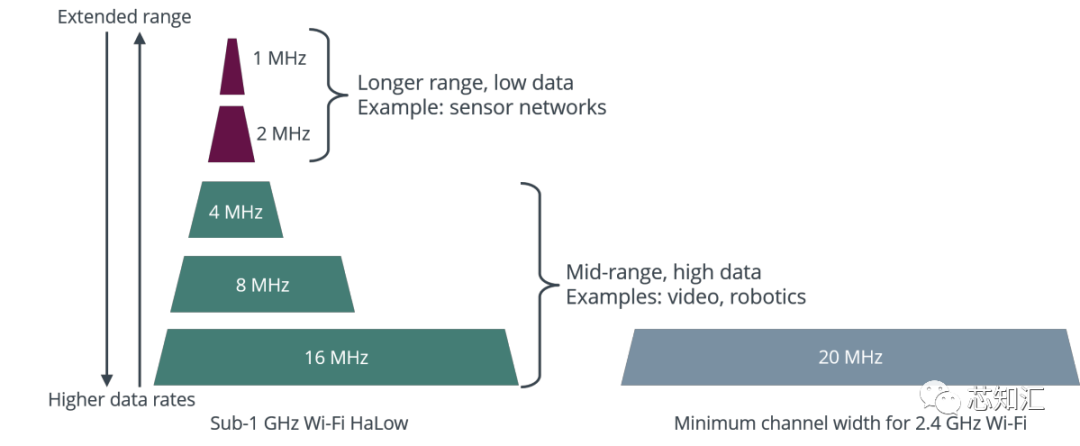
Another factor in predicting the success of long-distance RF signal transmission is the channel width over which energy is concentrated. A narrower channel within a given frequency range can concentrate transmission and reach farther than a wider channel at the same frequency. As shown in Figure 1, narrower channel modes operating at sub-1GHz frequencies provide greater coverage than wider channels at 2.4 GHz.
To be precise, the portion of the sub-1GHz band used by Wi-Fi HaLow varies according to market regulatory requirements. The United States currently uses 902 MHz to 928 MHz. Australia and New Zealand use 915 MHz to 928 MHz. Europe has allocated 7 MHz of spectrum between the 800 MHz and 900 MHz bands. Device manufacturers should consult local regulators to confirm which part of the sub-1GHz band is approved for use. To support product development for global deployment, the Wi-Fi Alliance actively advocates globally harmonized spectrum access for Wi-Fi HaLow in the 915 MHz to 925 MHz range.
Lower frequencies and narrower channels improve the link budget
One way to determine which IoT radio technology best meets application requirements is to evaluate the available link budget. Basically, link budget uses transmit power and transmission gains and losses (in decibels (dB)) to determine the received power of a transmission at a given distance. The IEEE 802.11ah standard specifies effective channel width options of 1, 2, 4, 8, and 16 MHz. Taking the United States as an example, in scenarios where Wi-Fi is considered an IoT radio option, Wi-Fi HaLow leverages sub-1GHz operating frequencies and narrow channel widths to achieve an 8 to 12 dB advantage compared with Wi-Fi in the 2.4 GHz band using 20 MHz-wide channels.
Wi-Fi HaLow can transmit data over longer distances in sub-1GHz bands, effectively addressing the needs of numerous IoT and industrial IoT applications while freeing up capacity in other bands where Wi-Fi operates. This makes Wi-Fi HaLow an excellent addition to the Wi-Fi portfolio, enabling various forms of Wi-Fi to handle virtually any use case, from low-bandwidth IoT network requirements to high-bandwidth-intensive applications.
Beacons are packets broadcast by an access point (AP) to synchronize the client devices it serves, and they set an upper limit on network range. Although Wi-Fi HaLow operates using Modulation and Coding Scheme 0 (MCS0) in a 1 MHz channel at 300 Kbps, Wi-Fi HaLow beacons have a 10 dB advantage over beacons sent at 6 Mbps in a 20 MHz channel. These effects combine to create a link budget advantage of about 20 dB, which translates to roughly a 10x distance advantage compared with 2.4 GHz Wi-Fi.
At the longest range (about 1 km), Wi-Fi HaLow operates in MCS 10 mode, with data repeated at 300 kbps in a 1 MHz channel, effectively achieving a data rate of 150 kbps. This meaningful redundancy gives receiving devices additional opportunities to correct data errors and provides another improvement to the Wi-Fi HaLow link budget. This combination of data rate and range exceeds many alternative wireless IoT technology options.
Orthogonal Frequency-Division Multiplexing (OFDM) Modulation and Forward Error Correction (FEC)
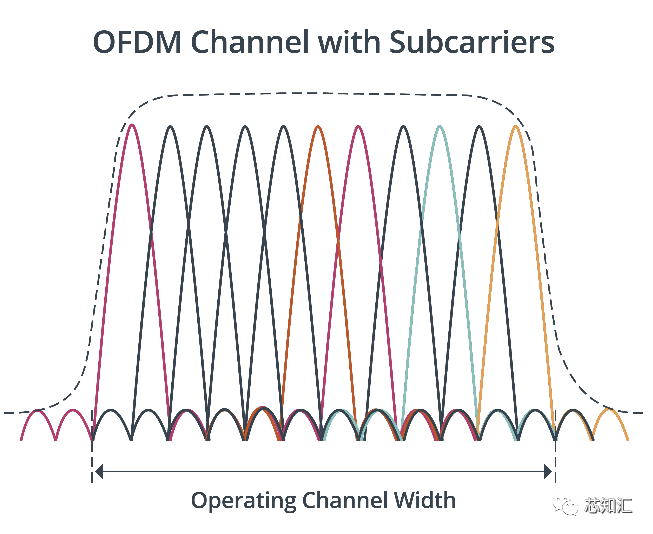
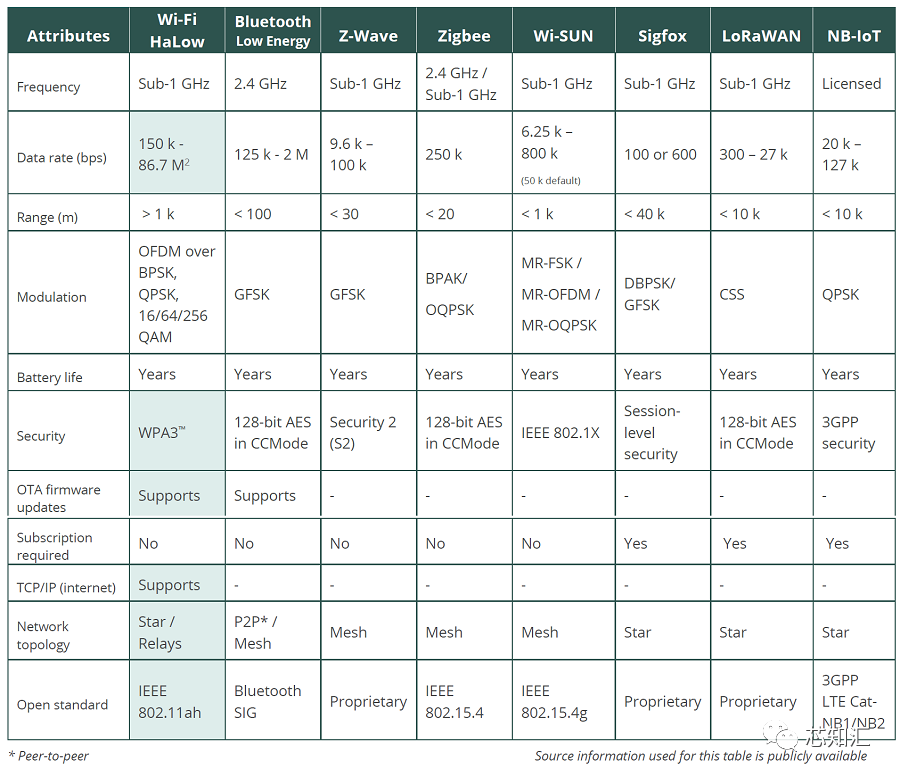
Wi-Fi HaLow uses OFDM modulation, which has been used in previous Wi-Fi generations since 802.11g. As shown in Figure 2, the data to be transmitted is encoded using a powerful forward error correction (FEC) code that adds valuable redundant check information, and the encoded stream can be sent simultaneously on 26 or more subcarriers distributed across the operating channel. Transmission across multiple subcarriers enables robust reception under channel distortion, while the redundancy improves the link budget of the received signal in the presence of interference and noise. OFDM combined with powerful FEC provides a more robust solution than simple frequency-shift keying (FSK)-type radios. Using OFDM combined with phase-shift keying (PSK) or quadrature amplitude modulation (QAM), Wi-Fi HaLow carries more data in a given period than other radio technologies. This spectral efficiency provided by Wi-Fi HaLow is especially important in countries/regions where the industrial, scientific, and medical (ISM) bands below 1 GHz are not widely available and duty-cycle limits apply to sensor devices. In many countries/regions, use of the ISM bands does not require a license. Wi-Fi HaLow provides data rates within this spectrum that are orders of magnitude higher than competing IoT technologies such as Sigfox, LoRaWAN, Zigbee, Z-Wave, Bluetooth Low Energy, NB-IoT, and other dedicated FSK radio systems, as shown in the table below.
Modulation and Coding Scheme (MCS)
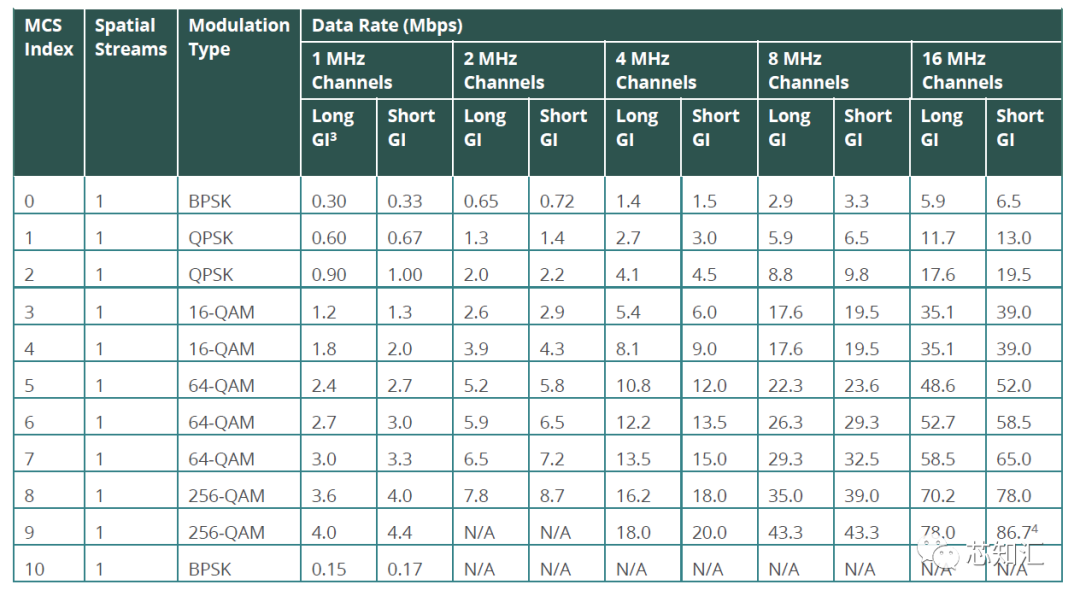
The Wi-Fi HaLow MCS table is derived from the IEEE 802.11ah specification. The table describes the modulation types, channel widths, guard intervals (GI) between symbols, and resulting data throughput. Access points (APs) and client devices automatically adjust to the best MCS supported by both to maximize data throughput under current channel conditions. Such MCS tables exist in Wi-Fi 4, Wi-Fi 5, and Wi-Fi 6. Data rates in the IEEE 802.11ah table are generally specified as one-tenth of those in the IEEE 802.11ac MCS table and can be used for up to four spatial streams. Although initial Wi-Fi HaLow implementations may target single-stream devices, there will be a path to four-stream multiple-input multiple-output (4x4 MIMO) Wi-Fi HaLow solutions in the future.
The MCS options take into account that the distance and RF conditions between two devices may change. Like other Wi-Fi technologies, Wi-Fi HaLow can adapt to changing conditions. Access points (APs) and client devices broadcast their capabilities when joining a network. They can automatically adjust to the best MCS as needed. For example, if an access point (AP) has an associated client running MCS 0 on a 1 MHz channel at 300 kbps, and both devices determine that the RF channel conditions between them are suitable for supporting MCS 4 on a 4 MHz channel, they can agree to change their MCS and channel bandwidth to transmit data at 9 Mbps.
The benefit of multiple MCS options is that administrators can tailor data rates to specific applications and allow mixed device types to automatically optimize as conditions improve. For example, a remote sensor that needs only 150 kbps can be served by the same access point (AP) as a nearby video camera that needs 10 Mbps. Devices closer to the access point (AP) typically operate at faster MCS rates, transmit their data, and save energy.
The following table shows MCS for a single-stream connection. Note that MCS 10 supports the lowest effective rate for long-distance connections, while MCS 0 through MCS 9 have progressively higher data rates.
Medium Access Control (MAC) Efficiency and Power Savings
One of the key design criteria of Wi-Fi HaLow technology is low power consumption, enabling battery-powered IoT devices to operate for years. New MAC features enable devices in Wi-Fi HaLow networks to save energy, reduce congestion, and increase capacity and device density. Transmitting radio signals generally consumes more power than receiving signals. Any reduction in device transmission usually saves energy. A key factor in low power consumption is ensuring that the radio can reliably remain in sleep mode for long periods without being dropped or disconnected by the access point (AP). By allowing Wi-Fi devices to sleep for more time, the average energy consumption of such devices can be greatly reduced. Devices in sleep or passive listening states free up available spectrum for active client devices to transmit their data. The main features of Wi-Fi HaLow efficiency and power savings are listed below.
Non-Traffic Indication Map (TIM) Mode Options
In some wireless local area networks (WLANs), devices must wake up frequently—multiple times per second—to monitor and respond to the traffic indication map (TIM) sent by an access point (AP) in beacon frames. The TIM is used to indicate which client devices should expect inbound data. Wi-Fi HaLow devices can save power by operating in an optional non-TIM mode, in which they do not need to remain active to actively monitor beacon frames. This capability eliminates the need for Wi-Fi client devices to check beacon messages periodically. Freedom from TIM mode allows Wi-Fi HaLow to conserve energy and thereby compete with other IoT sensor network technologies.
Note that non-TIM mode is an option, depending on the capabilities required by the device and network. Wi-Fi HaLow also supports TIM mode. A Wi-Fi HaLow AP can simultaneously support a mix of both types of devices.
Target Wake Time (TWT)
Client devices that wish to sleep for extended periods can negotiate a TWT agreement with the access point (AP). The AP stores all traffic destined for the client until the agreed wake-up time is reached. When the client device wakes at the specified time, it listens for its beacon and enables the AP to receive and send any required data before returning to sleep. The wake-up interval, negotiated between the client and AP, can range from very short (microseconds) to very long (years).
Restricted Access Window (RAW)
RAW is another scheduling method for communication among a group of client devices. For systems with predictable activity periods, the AP can grant a subset of clients with RAW privileges permission to transmit their data, while other clients can be forced to sleep, buffer non-urgent data, or both. Client devices can save power and preserve more network capacity for other time-critical traffic.
By combining TWT and RAW capabilities, network designers can minimize channel contention and reduce overall system power consumption.
Extended Maximum Idle Period
The extended maximum idle time capability extends the period during which a client device can remain asleep before the AP disassociates it. This retained state allows power-sensitive sensors to avoid wasting energy on re-authentication if they drop off the network. This feature provides a maximum idle time of more than five years. In practice, idle time depends on the implementation and application requirements.
Hierarchical Traffic Indication Map (TIM)
Hierarchical TIM is a more efficient way to encode the TIM described above, reducing its airtime and accommodating more clients. Different encoding modes are defined to efficiently manage large numbers of client devices in sleep mode.
Short MAC Header
Removing unnecessary header fields at the beginning of a packet reduces the occupied time for transmission and reception as well as the associated power consumption. For example, an 8% reduction in overhead for transmitting a small 100-byte packet would reduce it from 40% to 32%.
Null Data PHY Protocol Data Unit (NDP Frame)
The Null Data PHY Protocol Data Unit (referred to as an NDP frame) incorporates MAC-layer information into the PHY-layer signal field. This reduces packet size and transmission time relative to legacy management and control frames. For example, on a 1 MHz channel, MCS10 used for an NDP acknowledgment has an airtime of approximately 0.56 milliseconds (ms), whereas a legacy acknowledgment would take 1.34 ms.
Short Beacon Option
Beacons are typically transmitted at the lowest MCS rate to reach the farthest client devices in the coverage area, but their transmission time is long. Wi-Fi HaLow can recognize two types of beacons sent by an AP: full beacons sent less frequently, and short beacons with minimal information to maintain synchronization, which use less transmission time but are sent more frequently. Shorter beacons reduce power consumption for listening devices and free up valuable airtime in the spectrum.
Basic Service Set (BSS) Color
BSS coloring assigns a different 'color' to each access point (AP) or each BSS on an AP. This color coding is a simple indicator that enables client devices to pay attention to transmissions matching their BSS color and ignore transmissions from neighboring networks not intended for their BSS—that is, those whose BSS color does not match their associated BSS. This is intended to reduce medium contention overhead and increase overall capacity, especially in dense IoT networks.
Security
Authentication and Encryption
Wi-Fi HaLow supports the latest and most advanced Wi-Fi security technologies: Wi-Fi CERTIFIED WPA3™ and Wi-Fi CERTIFIED Enhanced Open™, based on Opportunistic Wireless Encryption (OWE). For example, the latter provides privacy in public environments where devices need to access cloud servers. Over time, Wi-Fi HaLow will adopt future Wi-Fi Alliance security improvements.
High-Speed Symmetric Data Throughput for Over-the-Air Firmware Updates
Wi-Fi HaLow's lowest effective MCS10 rate is 150 kbps, suitable for longer-range use. Nearby devices can use higher rates supporting tens of megabits per second. If a device needs new firmware to continue operating effectively and securely, Wi-Fi HaLow can deliver the information quickly and reduce downtime. This offers an advantage over PANs and wireless WANs, whose data rates are much lower—down to 100 bits per second. With such low data rates, these networks cannot provide the ability to rapidly respond to threats, requiring security updates to be pushed over the air to thousands of devices in the field. Devices using these technologies may experience long downtime, or incur higher maintenance costs by sending personnel to each device site to perform manual updates. Wi-Fi HaLow has the security, capacity, coverage, and data rate to support over-the-air updates with minimal downtime.
IoT Technology Competitive Analysis
The Wi-Fi Alliance compared Wi-Fi HaLow with other IoT technology options, analyzing data rate, coverage, battery life, ease of IP network integration, energy efficiency, and scalability. These attributes are defined in the table below.

Technologies analyzed include:
Unlicensed LPWAN: LoRaWAN, Sigfox, and Wi-SUN
PAN and LAN: Zigbee, Bluetooth Low Energy, Z-Wave, and 2.4 GHz Wi-Fi
Licensed WAN: NB-IoT, LTE-M
Prior to Wi-Fi HaLow, wireless IoT systems were usually designed to satisfy key operating parameters (such as long battery life) at the expense of other parameters (such as longer range, simplicity, or high data throughput). Low-power systems based on PAN technologies such as Bluetooth, Zigbee, Z-Wave, or proprietary radios sacrificed range, speed, or network simplicity.
The following information shows a comparison of Wi-Fi HaLow with other IoT technology options using these attributes. In this analysis, the closer a line is to the center, the less effective the technology is in that aspect. The farther the attribute line is from the center, the more effective it is.
Low-Power WAN Systems
As shown in Figure 3, LPWAN systems such as LoRaWAN and Sigfox provide long-range connectivity but perform poorly in terms of data rate, scale, energy efficiency, ease of IP integration, or security.
In the analysis, LoRaWAN is represented by a light blue line. It is the only technology that comes close to Wi-Fi HaLow in terms of range, battery life, and scalability. However, it still falls short in many respects in data rate and IP network integration. Similarly, Sigfox performs very well in range, but it underperforms in all other respects compared with its competitors in this scenario.
Compared with other LPWAN technologies, Wi-Fi HaLow excels in five of six aspects. Historically, people have assumed that Wi-Fi cannot be used for IoT because it is not energy-efficient. This is no longer true for Wi-Fi HaLow. Wi-Fi HaLow was developed specifically to improve device efficiency and includes the features described earlier that are dedicated to device power savings, enabling device batteries (including coin-cell batteries) to last for years.
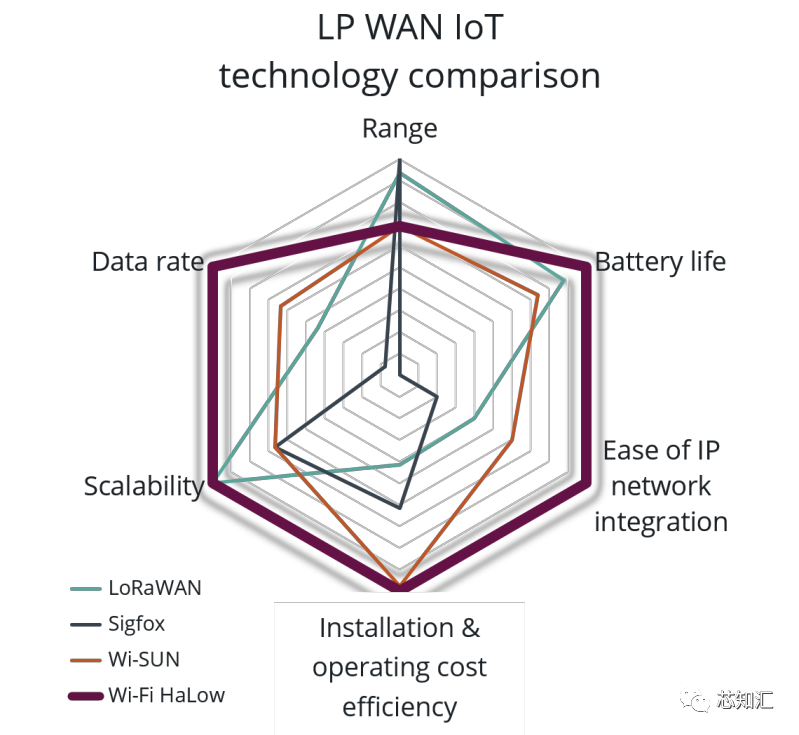
Compared with other low-power wide-area networks, Wi-Fi HaLow excels in most measured attributes
PAN and LAN Networks
Many types of PAN networks are designed for short-range connectivity. They attempt to achieve longer range through mesh architectures. Mesh architectures create multiple communication paths between devices. Although mesh architectures can simplify initial installation for users, they increase complexity, latency, and cost in IoT environments. Zigbee devices that relay traffic for other nodes within a mesh consume more battery energy and are limited to 250 kbps data throughput. The bottlenecks and latency of mesh architectures can prevent these systems from achieving Wi-Fi simplicity. Z-Wave mesh networks are limited to a maximum of 232 devices. Wi-Fi HaLow supports up to 8,191 devices per access point (AP) and does not require a proprietary gateway to access IP networks.
As shown in Figure 4, although each PAN/LAN technology performs well in installation and operational efficiency, the only other technology category that competes with Wi-Fi HaLow is 2.4 GHz Wi-Fi. This is where managers need to evaluate the primary goals of the IoT environment. When the most important factors are longer range and longer battery life, wall penetration, ease of installation, and scalability to more client devices, Wi-Fi HaLow is the clear choice. Ease of IP network integration and data throughput within access point (AP) range favor 2.4 GHz Wi-Fi because the technology is mature and already exists in many access points (APs) today. Adding Wi-Fi HaLow to a Wi-Fi 4, Wi-Fi 5, or Wi-Fi 6 network enables users to meet almost any requirement on the same IT infrastructure without interference.
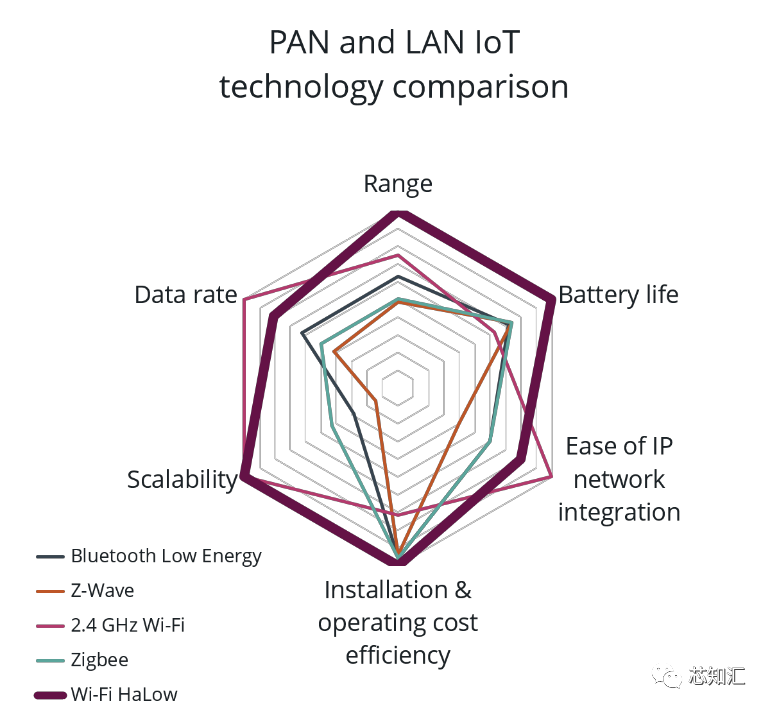
Compared with other IoT technology options, Wi-Fi HaLow meets key requirements
Licensed WAN Technologies
WAN technologies such as NB-IoT or LTE-M use licensed spectrum from carriers or mobile telephone service providers. Despite the promise of ubiquitous network coverage, these systems add a recurring cost burden to IoT networks by requiring data plan subscriptions to use mobile cellular infrastructure.
Compared with LTE-M, Wi-Fi HaLow achieves significantly higher data rates for clients within access point (AP) range, reaching a maximum downlink data rate of 4 Mbps using 5 MHz bandwidth; compared with NB-IoT, it reaches a data rate of 127 kbps using 180 kHz bandwidth. In this analysis, Wi-Fi HaLow outperforms the other technologies in every respect except coverage (see Figure 5). With a coverage range of 1 km, Wi-Fi HaLow can potentially meet the requirements of many IoT use cases within an enterprise.
Wi-Fi HaLow provides a low-cost solution for applications in which devices are within access point (AP) range, along with the advantages of longer battery life, easy IP network integration, and higher data rates. Wi-Fi HaLow is a good choice for aggregating traffic in dense deployments of low-power client devices, which can then be routed to the Internet. If a carrier network is unavailable, a Wi-Fi HaLow network can continue to operate as a LAN.
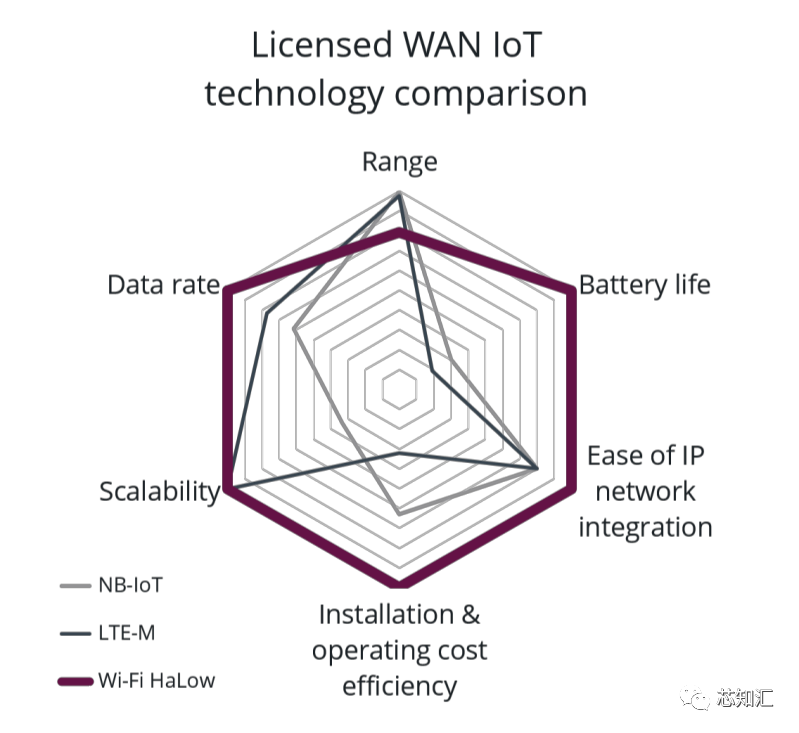
The cost-effectiveness, scalability, and native IP support of Wi-Fi HaLow make it an excellent alternative to expensive licensed or proprietary IoT technologies
Comparison of IoT Device Energy Efficiency
The IMEC research group conducted a study comparing the energy consumption of sub-1 GHz wireless technologies. The group conducted two different experiments. One experiment compared the long-range technologies NB-IoT, LoRaWAN, and Sigfox; the other compared Wi-SUN, based on IEEE 802.15.4 Zigbee technology, and Wi-Fi HaLow.
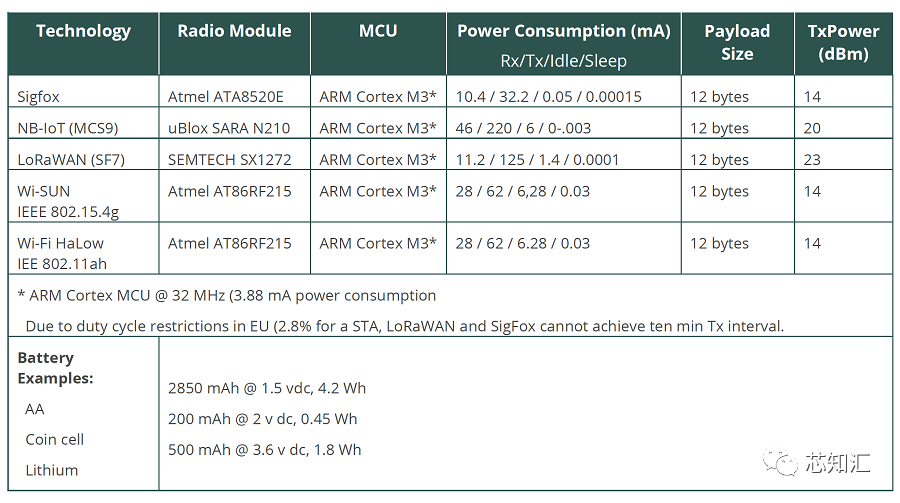
To ensure a fair and objective comparison of these five solutions, the study assumed that a 12-byte data packet is sent every 10 minutes. Power consumption was measured during operation of each system. Note that because Sigfox was included in the comparison, this study selected a 12-byte packet, which is very small for Wi-Fi HaLow. In real applications, Wi-Fi HaLow transmits packets up to 1,500 bytes at a transmission rate 15 times that of Sigfox.
IMEC Study Assumptions
The following table lists the assumptions used to calculate battery life as shown in the IMEC simulation results. They are based on energy consumption for a 10-minute transmission interval: one message sent every 600 seconds, using an example radio plus microcontroller (MCU) semiconductor solution. Note that other Wi-Fi HaLow technology vendors may show different results.
Energy Efficiency (bits/joule)
This study defines energy efficiency as how many bits of data can be sent or received using 1 joule of energy. As shown in Figure 6, when comparing key IoT technology options and assuming a 10-minute transmission interval, Wi-Fi HaLow is much more energy-efficient in terms of bits per joule because its transmission time is relatively short. In this study, the other technologies required much longer to transmit packets of the same length. For example, Wi-Fi HaLow sends 22.4 kb per joule, compared with 3.7 kb per joule for NB-IoT. This sixfold advantage for Wi-Fi HaLow translates into longer device battery life.
The study also showed that for simple networks, Wi-Fi HaLow is four times more energy-efficient than LoRaWAN and Wi-SUN. As more nodes join the mesh network, Wi-SUN energy efficiency decreases slightly, while Wi-Fi HaLow energy efficiency remains relatively unchanged.
The study demonstrated that Wi-Fi HaLow is more energy-efficient than the other technology options.
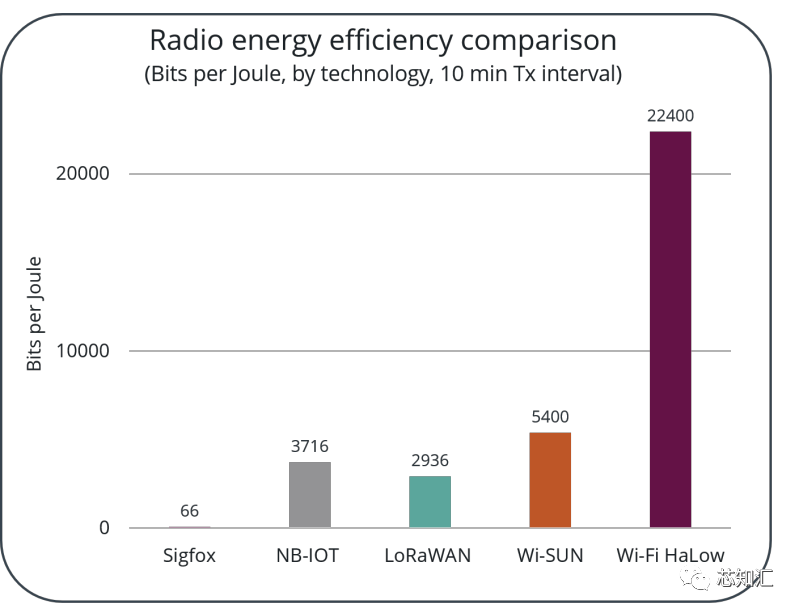
Wi-Fi HaLow is at least four times more energy-efficient than several other IoT technology options
Battery Life
Based on battery capacity
By understanding the energy consumption of each technology, it is possible to predict battery life for different battery capacities for each IoT technology. The joules of energy stored in a battery are related to its rated capacity, usually expressed in milliampere-hours (mAh).
The chart on the left in Figure 7 shows Wi-Fi HaLow battery life with different battery capacities. Many common 3 V coin cells have a capacity of 250 mAh. A typical AA 1.5 V alkaline battery has an average rated capacity of 2,000 mAh and can be used in larger devices. The findings show that in this challenging IoT use case, Wi-Fi HaLow can operate for more than a year and a half on a coin cell while transmitting every 10 minutes. Regardless of battery size, the study shows that Wi-Fi HaLow can support small coin-cell-powered IoT devices and outperforms other technologies in many applications.
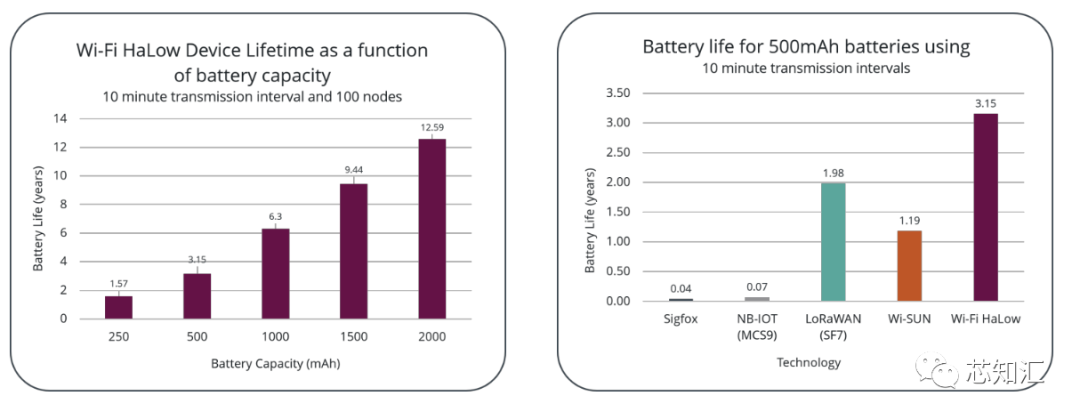
The figure illustrates Wi-Fi HaLow battery life based on battery capacity (left) and transmission frequency (right).
Based on transmission frequency
The study focuses on comparing technologies using a 10-minute transmission interval. Technologies that require more frequent communication between data transmissions will suffer from shortened battery life. Wi-Fi HaLow has been shown to extend sleep time significantly. Features such as TWT and BSS Extended Max Idle enable Wi-Fi HaLow devices to sleep for hours, days, months, or even years between wake-up operations.
Study Conclusions
When comparing bandwidth, data rate, and topology, Wi-Fi HaLow demonstrates clear advantages over Sigfox, NB-IoT, LoRaWAN, and Wi-SUN. In similar use cases, Wi-Fi HaLow is the most energy-efficient compared with these other technologies. The IMEC research team's evaluation determined that Wi-Fi HaLow is not only more than four times more energy-efficient than other widely recognized long-range technologies, but also provides higher data throughput than other IoT technology options. The team also determined that Wi-Fi HaLow devices using typical alkaline AA batteries can operate for more than 10 years, longer than the typical battery shelf life.
Summary
Wi-Fi HaLow clearly meets and in many cases exceeds the key requirements for IoT connectivity and applications. The ability to adapt to a wide range of IoT use cases in terms of distance, data rate, and energy efficiency is crucial to the success of IoT technology.
Wi-Fi HaLow's sub-1 GHz operating frequency and narrow channels enable longer range (about 1 km) and improved penetration through walls and obstacles. Its unique suite of energy-saving features reduces device power consumption, improves energy efficiency, enables multi-year battery operation, and supports coin-cell batteries. It supports a variety of data rates, accommodating use cases ranging from low-data sensor networks to high-data-rate video systems. New Wi-Fi HaLow PHY and MAC features enable each access point (AP) to support thousands of devices while improving radio spectrum utilization.
Because Wi-Fi HaLow is part of the IEEE 802.11 and Wi-Fi portfolio, it is an open standard that delivers more efficient installation and operating costs without the need for proprietary controllers, hubs, or gateways. Wi-Fi HaLow networks can be deployed in the presence of existing Wi-Fi 4, Wi-Fi 5, and Wi-Fi 6 networks without affecting their RF performance. Native IP support and advanced security with WPA3™ make access to cloud-based applications and over-the-air updates simpler and more secure.
Related comparative studies show that Wi-Fi HaLow is several times more energy-efficient than other wireless technologies. It can transmit more data per joule of energy, helping ensure longer device battery life. Its star-oriented architecture provides long-range connectivity and eliminates the data bottlenecks and latency caused by mesh networks. As part of the complete Wi-Fi portfolio, Wi-Fi HaLow offers a more comprehensive approach to connectivity and extends current Wi-Fi coverage to hard-to-reach places such as garages, basements, attics, warehouses, factories, and large outdoor areas. Wi-Fi HaLow enables network designers to deploy IoT networks using a single, standards-based, IP-ready, reliable architecture without sacrificing simplicity and efficiency.
This article is reprinted from Xinzhihui.

Zhuhai Taixin Semiconductor Co., Ltd.
Zhuhai Taixin Semiconductor Co., Ltd. was founded in 2016 and is a high-tech enterprise integrating IC design and wireless intelligent communication solutions. We have successively launched long-range, low-power Wi-Fi chips for the Internet of Things, low-power motor controller chips, and related product solutions. The company adheres to a market-oriented and technology-driven approach, providing customers with high-quality chips and product technology solutions.
Core products of the company: long-range, low-power Wi-Fi communication chips for the Internet of Things. These chips can be used in product areas such as smart homes, security surveillance, UAV video transmission, smart meter reading, smart door locks, smart grids, smart hospitals, and logistics robots. They have been successfully adopted by core enterprises such as Hikvision, TP-Link, Fullhan Microelectronics, and Alibaba Group's Cainiao Network Technology.