
News detail
Handheld Gimbal or Detachable Magnetic Camera: Start With These Two Chips

Pocket gimbal cameras and detachable cameras
Their appearances are very different.
Their use cases are different as well.
Take the housings apart,
and the chip inside
is doing the same job:
It takes the image sensor's
incoming images and processes them,
compresses them, transmits them, and displays them.
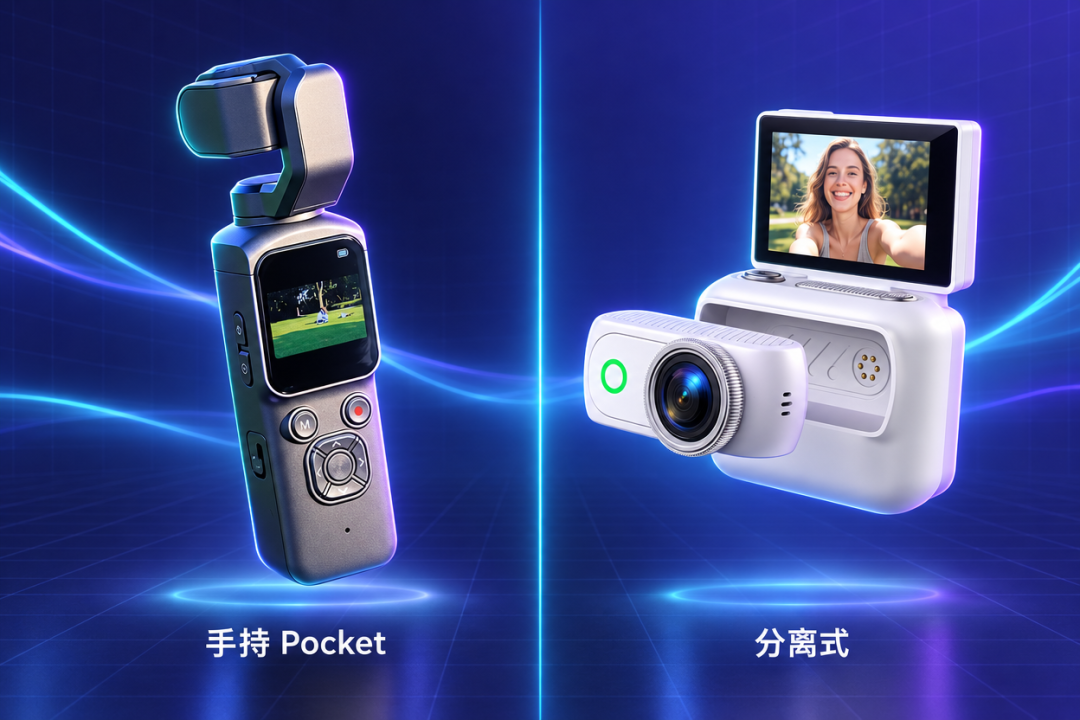
The difference is in chip selection.A device with a screen and gimbal that you hold and shoot with as a standalone unit, and a device whose lens and screen are separate, with the lens magnetically attached to a collar or handlebar, have completely different requirements for camera interface, memory, and wireless connectivity.
Two form factors, two chips.
For handheld Pocket devices
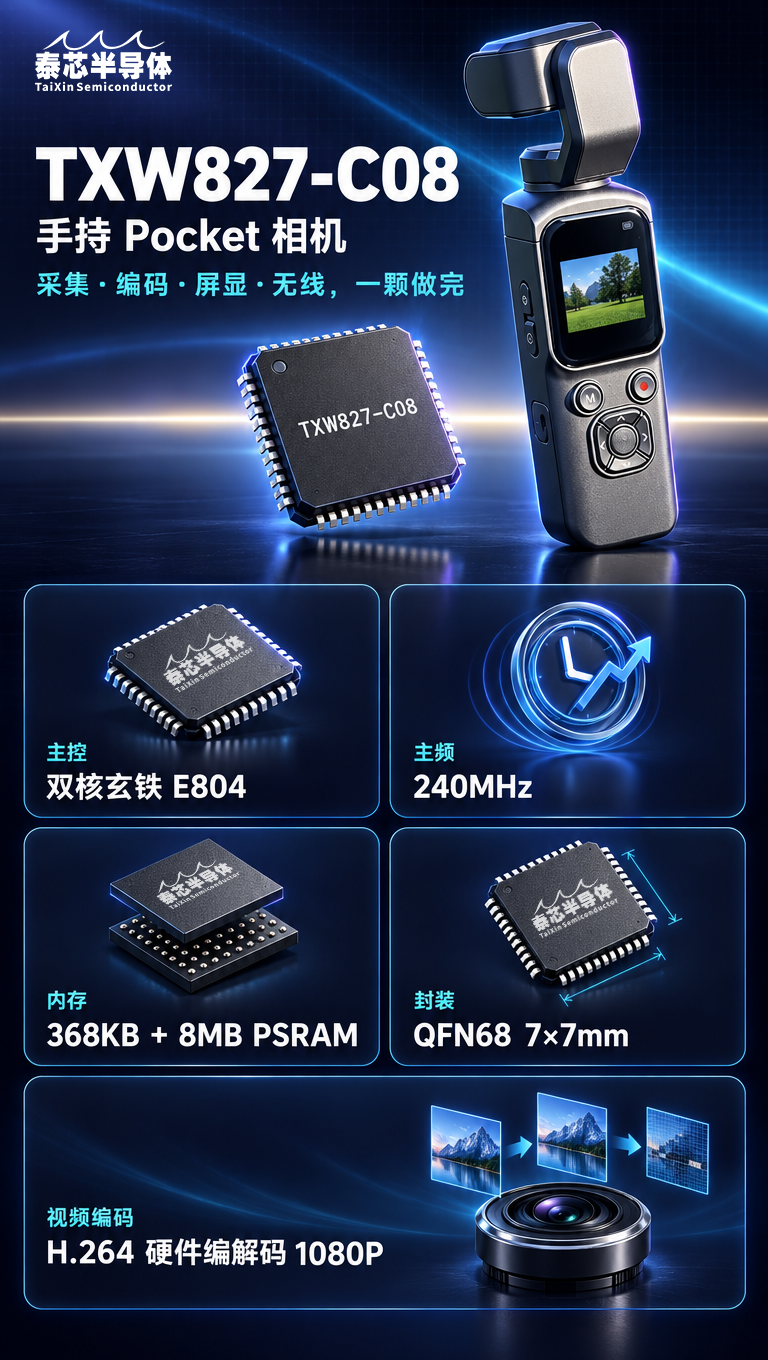
Capture, encoding, on-screen display, and wireless are all handled by this single chip. It features dual-core XuanTie E804 at 240 MHz, 368 KB on-chip RAM plus 8 MB PSRAM, a QFN68 package, a MIPI CSI camera interface supporting up to 1920×1080, H.264 hardware encoding/decoding, and display support for RGB / MCU / MIPI DSI.
These products have screens and gimbals, so both image processing and buffering need headroom; the 8 MB PSRAM and 2-lane MIPI DSI are there for exactly this.
For detachable action cameras
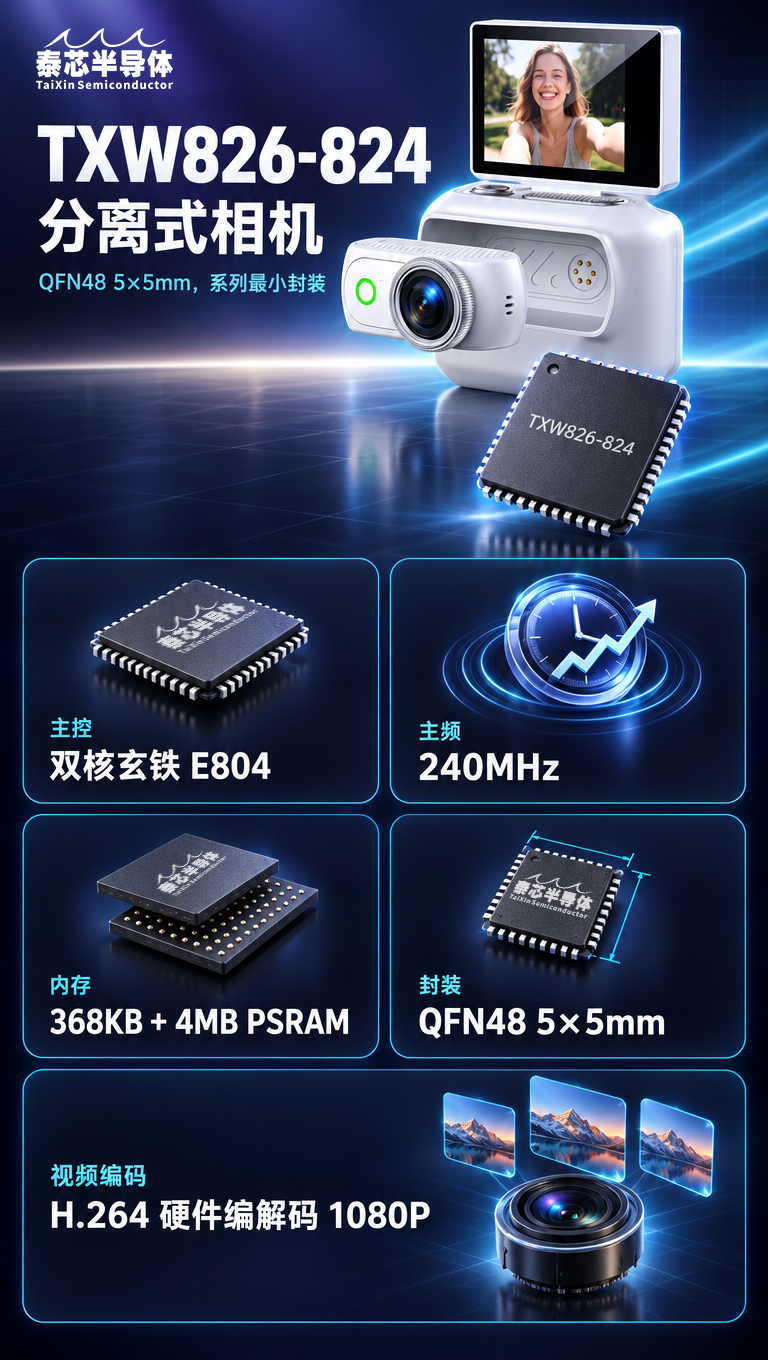
Dual-core XuanTie E804 at 240 MHz, 368 KB + 4 MB PSRAM, 2 MB on-chip Flash, and a camera interface via MIPI CSI.
The key for this chip is its package
QFN48, 5×5 mm
It is the smallest member of the TXW82X series.
The detachable lens must magnetically attach to a collar, handlebar, or backpack strap, so small size and light weight are hard requirements; the lens board should carry as few components as possible, and the 2 MB on-chip Flash eliminates one external memory chip. Capture, encode, transmit—these are the only three things this chip needs to do.
Face tracking: how the chip 'sees' a person
In selfie application scenarios,
changes in the subject's position and posture
can easily cause the subject to move out of the frame
when the camera position is fixed,
the composition must be adjusted manually again and again
otherwise the final footage will be missing the subject.

A gimbal can solve part of the problem—the motor can turn. But the prerequisite is that it must first know which way the person is moving.
On Taixin’s chips, this capability is delivered througha software implementation running on the CPU, requiring no external algorithm chip and no additional NPU on the BOM. For system builders, this is a capability they can gain without increasing hardware cost.
More important is the headroom.With face tracking enabled, H.264 encoding and screen display can still run normally, without dropping frames or stopping a stream simply because one more algorithm is running.
After a face is recognized, the gimbal motor can be used to turn the camera to follow the person. Taixin can provide technical support for gimbal linkage here, so customers do not have to build this chain from scratch.
The key hurdles the product must clear
Encoding
These products need to record and transmit simultaneously. The chip integrates H.264 hardware encoding and decoding, so the compression step does not consume CPU compute; the bitstream is small, bandwidth usage is low, and storage is saved, with no transcoding required on the client or platform side. Local recording uses 1080P H.264.
Connectivity
Video transmission relies on the chip’s wireless capabilities. For the handheld path, recorded content is sent to the mobile app via Wi-Fi; for the split-type path, the captured video must also be transmitted to the screen and sent over Wi-Fi for display. The stability and latency of these two links are the most sensitive aspects of the user experience for this type of product.
Coordination with the gimbal
The handheld gimbal path adds another step: the chip is responsible for “seeing where the person is,” and the gimbal motor is responsible for “turning the lens toward them.” Only when the two are connected does follow recording work.
Power consumption
These products are mostly battery-powered and record, transmit, and display simultaneously, so the battery drains faster than expected. For the handheld Pocket path, typical current during recording is around 200mA—this level determines how small the battery can be made and how long it can last per charge.
How to choose
For handheld gimbals, subject-following recording, and screen connectivity
▼▼▼
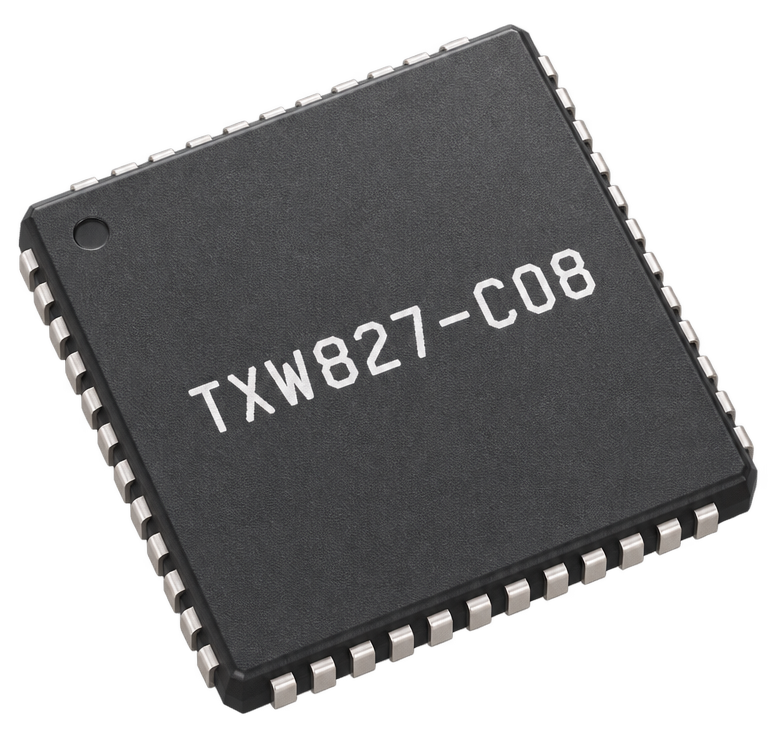
One chip does it all
(QFN68, 8MB PSRAM, with MIPI DSI)
For split-type / magnetic-attach form factors and compact lenses
▼▼▼
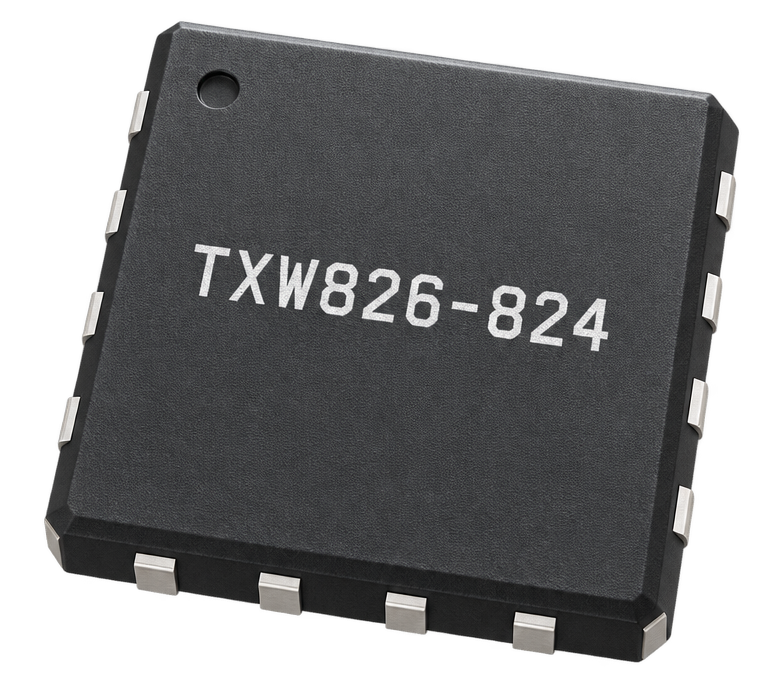
One chip does it all
(QFN48 5×5, 1080P local recording)
The choice is not about which chip is more powerful
It is about what the product needs to become
Once the form factor is defined
the chip is essentially decided
Beyond the Chip
Taixin provides reference designs plus an SDK. Device provisioning, production testing, and audio/video pipelines are all covered within this system, with direct support from the technical team.
Taixin already offers complete solutions for both form factors. When customers come with a product form factor, they can directly adapt an existing solution rather than starting over at the chip selection stage.
Handheld products use one chip; split-type products use another. The form factors differ, but the underlying capabilities are the same.
What the product looks like, who it is sold to, and how it is priced
are defined by the customer
At the chip level
we make it stable and cost-efficient
and leave room for choice

Zhuhai Taixin Semiconductor Co., Ltd. was founded in November 2016. It is a national-level specialized, refined, distinctive and innovative "Key Little Giant" enterprise focused on chip design for the AIoT field, and has been listed on the "China IC Unicorn" list. With outstanding technical strength, the company's products have twice won the prestigious "China Chip" industry award.
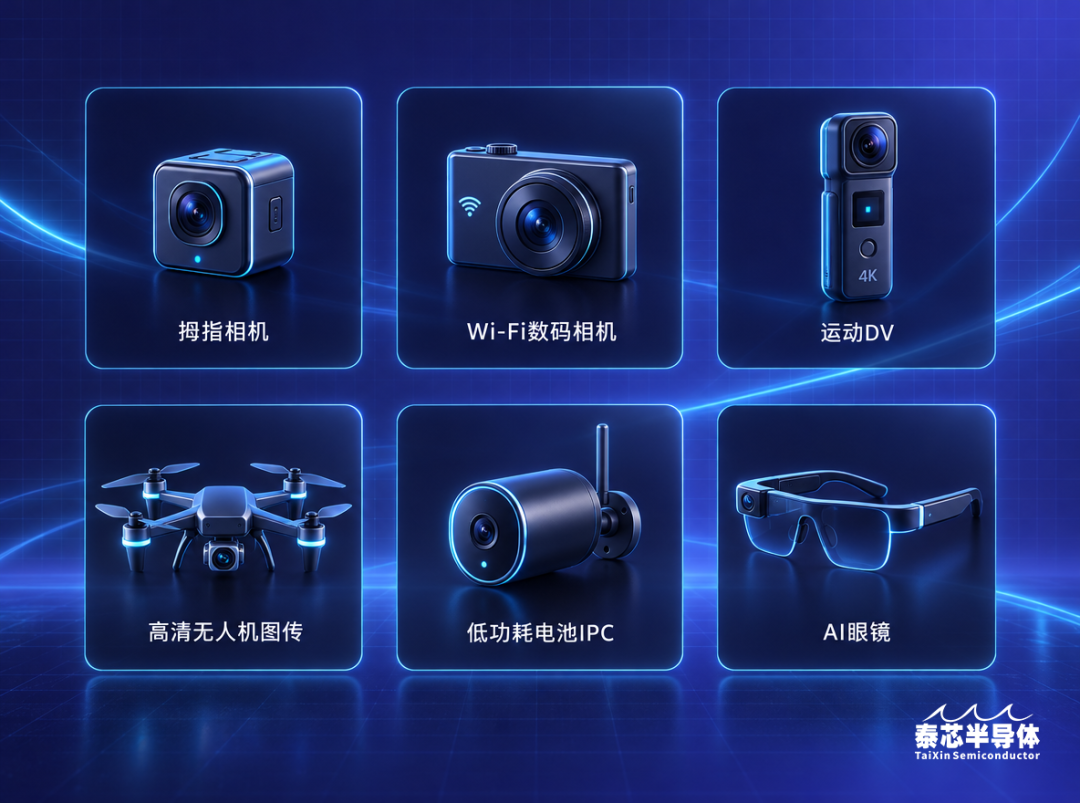
The company has deep expertise in core technologies for wireless communications and audio/video processing, with full-stack in-house R&D capabilities covering baseband, protocol stacks, and RF circuits. As one of the world's first companies to achieve mass production of Wi-Fi HaLowTMchips, Taixin has established a first-mover advantage in long-range IoT with ultra-strong penetration and ultra-low power consumption. At the same time, the company was among the first to launch audio/video SoC chips integrating SparkLink technology; with low latency and strong interference resistance, these chips fully empower cutting-edge audio/video scenarios such as AI glasses, high-definition drone image transmission, and video doorbells.
In terms of technology layout, the company has proactively deployed LTE Cat.1 chips, further completing its mid-rate IoT technology portfolio and successfully building a dual-technology-driven system of "wireless + cellular." Its product matrix fully covers ultra-long-range, low-power, multi-protocol integrated, and complex industrial-grade scenarios, broadly empowering diverse fields such as consumer electronics, security monitoring, smart home, embodied robots, connected vehicles, and the Industrial Internet, and has been recognized by many leading customers including Hikvision with large-volume shipments.
As an active promoter of the industry ecosystem, Taixin Semiconductor is a full member of the Wi-Fi Alliance, SparkLink Alliance, Wi-SUN Alliance, and RISC-V Alliance. In the future, the company will continue to uphold its corporate culture of "diligence, innovation, pragmatism, and growth," and through continuous technological innovation and application expansion, provide global customers with high-performance, stable, reliable, and cost-effective one-stop AIoT chips and solutions, contributing to the vigorous development of the era of ubiquitous intelligent connectivity.

Company Profile /Company Introduction