News detail
News Sharing | Chip Imports Continue to Rise, Beware of 'Chip Involution' Chaos
Source: Zhong Lin Tan Xin. Chips, hailed as the 'new oil' of the digital age, have seen their strategic status increasingly highlighted. According to data from China Customs, in t…

Chips, hailed as the 'new oil' of the digital age, have seen their strategic status increasingly highlighted.
According to data from China Customs,2026the first two months, chip imports amounted to550.268billion RMB(approximately770billion USD), year-on-year increase of36.8%. Reviewing chip import trends in recent years, the data is as follows:
2025year: approximately426.9billion USD (RMB approximately3.04trillion)
2024year:约3856亿美元(人民币约2.8万亿元)
2023年:约3494亿美元(人民币约2.5万亿元)
2022年:约4156亿美元(人民币约2.9trillion yuan)
2021year: approximately4325billion USD(approximately equivalent to3.1trillion RMB), representing a historical peak.
Based on the data, as 'domestic substitution' continues to advance, chip imports have declined annually, but by2024year again marked a new watershed.2024year, China's chip import value reached3856billion USD, a year-on-year increase of9.5%, continuing to firmly rank as China's largest imported commodity.During the same period, chip export value reached1595billion USD, growth rate was17.4%, becoming the top export commodity for the first time.These two sets of data—one in, one out—paint a complex picture of China's chip industry: on one hand, the huge demand for high-end chips still relies heavily on imports; on the other hand, exports of domestic mid-to-low-end chips have shown strong competitiveness.
However, beneath the facade of rapid industry development, a fierce 'involution' competition is quietly unfolding in the domestic chip market. The potential risks of this 'chip involution' warrant vigilance.
The so-called 'chip involution' refers to enterprises over-concentrating on homogenized competition within specific technology levels or market segments, leading to frequent price wars, severely compressed profit margins, and subsequently weakening the industry's overall innovation drive and sustainable development capabilities.
Currently, this phenomenon is particularly evident in the domestic chip industry, especially in the mid-to-low-end chip sector. A surge of capital has led numerous enterprises to focus on mature chip products with relatively low technical barriers and saturating markets, competing for market share through mass production and price competition.The result is that enterprises fall into blind following and resource consumption, yet struggle to build true core competitiveness,leading tothe proportion of loss-making companies in the domestic chip industry is approximately90%, after several years of marketization, these companies still find it difficult to turn a profit. This is precisely the industry's high degree of'involution'direct manifestation.
The consequences of this 'involution' battle are severe. For enterprises, continuous price wars mean sharply reduced profits or even losses. Relying solely on chip design and scale to reduce costs can no longer create a significant gap; in extreme cases, companies may even rely on low or zero gross margins to squeeze out competitors.However, this is not a healthy model. Once attempting to raise prices back to normal levels, competitors may quickly rebound, while potentially alienating customers.
A more profound impact is that excessive involution consumes resources and energy that enterprises should have used for upward breakthroughs. Industry laws indicate that no company can grow large by relying on 'domestic substitution' or 'substituting domestic products'; enterprise growth inevitably depends on technological upgrades and product innovation.'Involution' can only become a pure war of survival attrition, causing the entire industry to fall into a low-level cycle and delaying progress towards the high end.
Facing the dual challenges of import dependence and internal involution, China's chip industry needs to seek a way out. Without a shift in mindset, reliance on chip imports will only worsen. Foreign chip companies continue to innovate and create, while domestic chips persist in mid-to-low-end involution-based substitution.
The core value of chips has never been 'substitution', but 'creation'—using technology as a pen, sketching brand-new application scenarios on the canvas of human society and spawning unprecedented market demands. Foreign chip companies have always been creating: creating new technologies, creating new chip products, and creating new application demands. For example,AIchips make medical diagnosis more precise, autonomous driving safer, and artistic creation more convenient, expanding the boundaries of work and life; process breakthroughs spawnAI智能手机,ASIC技术孵化数字经济,量子芯片将重塑信息产业格局,每一次技术跃迁都创造出需求蓝海。
从“替代”到“创造”,是国内芯片产业思维的革新。
有些芯片企业借“国产替代”的东风成功登陆科创板,却始终难以挣脱“替代”思维的枷锁。从最初对标海外产品实现“国产替代”,到后来在国内市场陷入“替代国产”的内耗循环,这种路径依赖正不断消磨企业自主创新的动力与能力。
庆幸的是,也有像晶丰明源这样的国内芯片上市公司,敢于向上卷,卷技术、卷创造;敢于与国际巨头芯片企业在最高端同台竞技,成功将电源管理芯片打入AI算力领域。
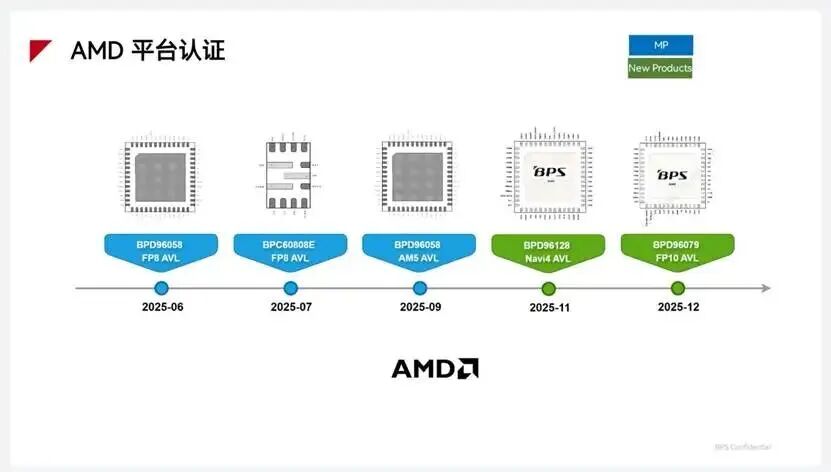
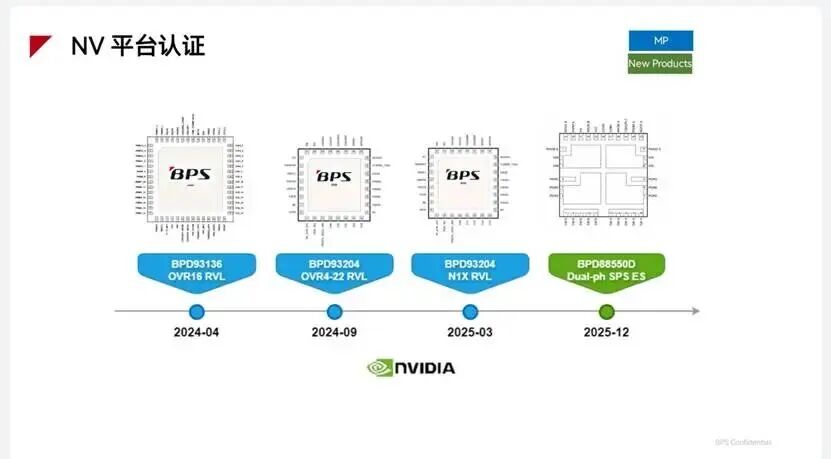
(图自转自网络)
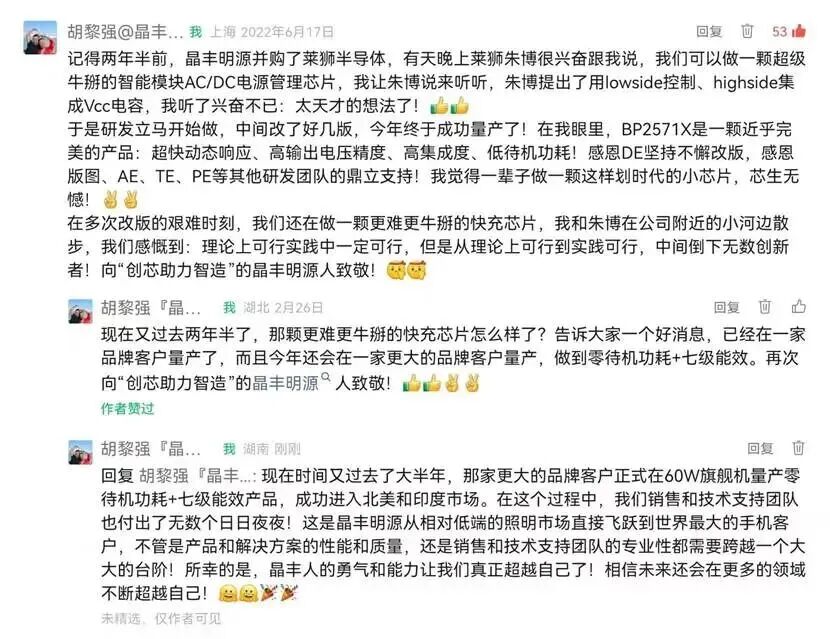
取得这样的成就背后是五年磨一剑,芯片行业挣不了快钱,全是耐心。晶丰明源胡总在朋友圈有感而发:五年磨一剑,全球唯一!感谢智融ODM协议芯片,感谢纳芯提供数字隔离想法,感谢群芯代工磁耦BP818,感恩VDE洪炜搞定BP818磁耦VDE/UL/3C全球安规认证,感恩老活宝朋友朱臻博士,感恩女神郜小茹,感恩女神Shirley,感恩王佳在2022年5月上海疫情封城期间带着大女儿从美国来到上海,感恩很多奋斗了五年多的同事和合作伙伴,我们共同开创一个新时代,从致敬经典到创造经典!
(图自转自网络)
这是一个值得感恩的时代,我们这一代人在不断创造历史。只有创造才有未来,在科技浪潮奔涌的今天,创造更是时代的刚需。那些看似遥不可及的黑科技,那些颠覆生活方式的新发明,起初都只是某个头脑中一闪而过的奇思妙想。正是因为有人敢于把“不可能”变为“可能”,我们才有了自动驾驶的便捷、人工智能的赋能、基因编辑的希望。
我也坚信,会有越来越多像三伍微和泰芯半导体这样以技术/Unlisted chip companies driven by product innovation, because only through innovation and creation can unlisted chip companies survive and develop in the market. The era of "import substitution" has passed; without innovation and creation, any amount of capital burning by chip companies is in vain.
According to relevant data statistics, conservatively estimated over the past5years (2021–2025) domestic chip design industrycumulative investment amountbetween1.2trillion to1.5trillion RMB, the number of domestic chip design companies has increased to3901companiesThese chip companies were originally mostly aiming for "import substitution". Every niche sector is already overcrowded, and chip products have moved from "import substitution" to "substituting domestic products"".
The path of "import substitution" has been completely blocked, and "substituting domestic products" is even more of a dead end. Taixin Semiconductor and Sanwu Micro created new demand through product innovation,2025year-end viral video intercom is a classic successful case of cooperation between the two companies. From requirement proposal to chip design, then to mass production, it took two years. Deep collaboration and co-creation with customers were the key drivers for the category's eventual viral success.
Once chip enterprises possess innovative thinking and creative drive, market opportunities will arrive continuously. Taixin Semiconductor focuses onAIoTfield chip design, integrating wireless connectivity (Wi-Fi4/6,Wi-Fi HaLow, Bluetooth, NearLink,Wi-SUN), audio/video processing andAIalgorithm technologies. Based on technology and oriented towards the market, adopting differentiated competition to create new market opportunities through innovation. Recently, TaixinxClaude Opus AIreconstructed a limited edition1080P IPCproduction speed ceiling,30days from0to mass production, audio/videoWi-Fi SOCdoes not rely onDDR2, but rather achieves it throughPSRAMimplementation, once again demonstrating the power of innovation.
This innovative confidence validates an industry consensus: competition in the chip industry is never a short-term speed contest, but a marathon of endurance and wisdom. By embracing global cooperation with an open mindset and deepening independent innovation with firm resolve, the "involution" chaos that once alarmed us will ultimately transform into momentum driving industrial upgrades, leading Chinese chips to achieve their own acceleration on the global stage.
After all, the future is not waited for, nor is it born of "involution"; it is created. Only with creation as our oar and courage as our sail can we ride the waves of the era and sail towards a brilliant horizon.