At 09:22 Beijing Time on June 17, 2021, the Long March-2F Y12 launch vehicle carrying the Shenzhou-12 crewed spacecraft, at the Jiuquan Satellite Launch Center...
At 09:22 Beijing Time on June 17, 2021,the Long March-2F Y12 launch vehicle carrying the Shenzhou-12 crewed spacecraft ignited and lifted off on schedule at the Jiuquan Satellite Launch Center, and about 573 seconds later, the Shenzhou-12 crewed spacecraft successfully separated from the rocket and entered its predetermined orbit, smoothly sending the three astronauts Nie Haisheng, Liu Boming, and Tang Hongbo into space. The flight crew is in good condition, and the launch was a complete success.This is the 19th flight mission since the establishment and implementation of China's crewed space program,and also the first crewed flight mission in the space station phase.View the original video on the WeChat public account(Video source: CCTV News)According to the China Manned Space Engineering Office, after entering orbit, the Shenzhou-12 crewed spacecraft successfully completed its in-orbit state setup and, at 15:54 Beijing Time on June 17, 2021, successfully docked with the forward port of the Tianhe core module in autonomous fast rendezvous and docking mode. Together with the previously docked Tianzhou-2 cargo spacecraft, it formed a three-module (spacecraft) combination. The entire rendezvous and docking process lasted about 6.5 hours.This is the first rendezvous and docking with a crewed spacecraft after the Tianhe core module was launched into orbit.According to the mission implementation plan, the three astronauts will subsequently enter the Tianhe core module from the Shenzhou-12 crewed spacecraft.View the original video on the WeChat public account
(Video source: CCTV News)
What are the tasks of this flight?
According to the overall arrangements for the Shenzhou-12 crewed flight mission, during their time in orbit, the three astronauts will mainly complete work in four areas and plan to carry out two extravehicular activities and extravehicular operations.Overall, the Shenzhou-12 flight mission has the following four main features:
First, it will further verify the functions and performance of the crewed Earth-to-orbit transportation system. The improved Long March-2F launch vehicle has enhanced reliability and safety; the Shenzhou-12 crewed spacecraft has newly added autonomous fast rendezvous and docking, radial rendezvous and docking, and 180-day in-orbit docking capabilities. Return technology has been improved, further increasing landing point accuracy,and will also activate the crewed spacecraft emergency rescue mission mode for the first time. Second, it will comprehensively verify technologies for supporting long-term astronaut stays.Through the Shenzhou-12 astronaut crew working and living in orbit for three months,, it will assess and verify various support technologies for long-term spaceflight by astronauts, including regenerative life support, space station material supply, and astronaut health management. Third, it will verify in orbit the ability of astronauts and the robotic arm to jointly complete extravehicular activities and extravehicular operations. With the support of the robotic arm, the astronauts willfor the first time carry out a relatively long-duration extravehicular activity, and perform extravehicular equipment installation, maintenance and repair, and other operational tasks. Fourth, it will test the search and recovery capabilities of the Dongfeng Landing Site for the first time. The landing site has been adjusted from Siziwang Banner in Inner Mongolia to the Dongfeng Landing Site,and will activate the landing site system's normalized emergency standby search and rescue mode for the first time. These technological breakthroughs and capability verifications will lay a solid foundation and accumulate valuable experience for the subsequent construction and application development of the space station.
A 'Big Spoiler' of Space Life
The Shenzhou-12 astronaut crew will work and live in orbit for three months. So, is the 'space home' built for them comfortable? How do the astronauts live in space?
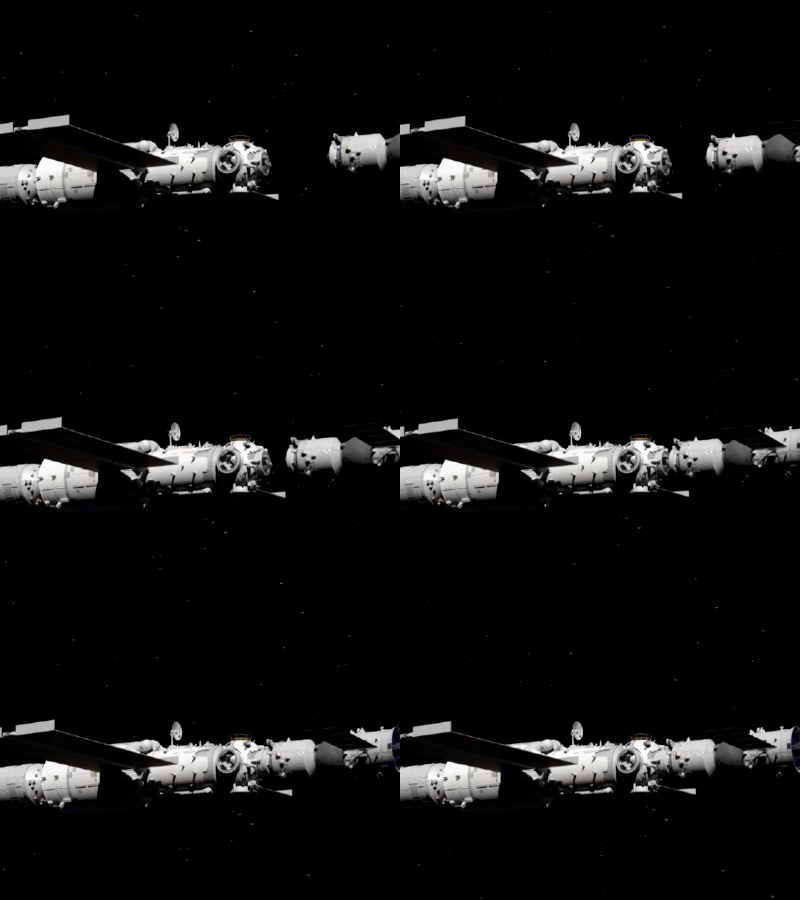
▲ Rendezvous and docking of the Shenzhou crewed spacecraft with the combination of the space station's Tianhe core module and the Tianzhou cargo spacecraft
From a 'tube room' to a 'large flat'
Tiangong-1 was successfully launched in 2011, with a launch weight of about 8 tonnes and a habitable volume of 15 cubic meters for astronauts, sufficient to meet the needs of three astronauts working and living in orbit at the same time. This represented a significant improvement over the 7 cubic meters of habitable volume on Shenzhou-7, but it was still relatively cramped.When China began building its space station in 2021, designers set aside a relatively ample living environment for astronauts to improve their comfort in space. The habitable volume increased from 15 cubic meters on Tiangong-1 to 110 cubic meters for the entire station, as if moving from a 'tube room' into a 'large flat.'
Enjoy whole-home Wi-Fi smart living
With the continuous leaps in China's wireless communications and IoT technologies over more than a decade, designers kept upgrading the earlier overall design and adopted new information technologies, giving China's space station 'mobile Wi-Fi' and creating a smart home living space. On China's space station, designers prepared a handheld terminal for each astronaut. Astronauts can adjust the cabin lighting environment through an app according to their personal needs: sleep mode, work mode, exercise mode, and so on. Different cabin lighting can help regulate astronauts' emotions and avoid the discomfort caused by being in a monotonous environment for long periods. For the cabin lighting and temperature environments alone, designers conducted multiple trials, repeatedly verifying and adjusting them to give astronauts on long-duration space missions the most comfortable possible living experience. Normally, astronauts wear bone-conduction headsets. The Wi-Fi in the cabin allows them to communicate with each other across the station's modules, and they can also talk to the ground from any location.In addition, in previous crewed spaceflight activities, space-to-ground calls were a 'traditional item.' During the operation of China's space station, designers will reserve a private voice channel for astronauts, where they can call their families and 'whisper' to share their feelings about life in space.
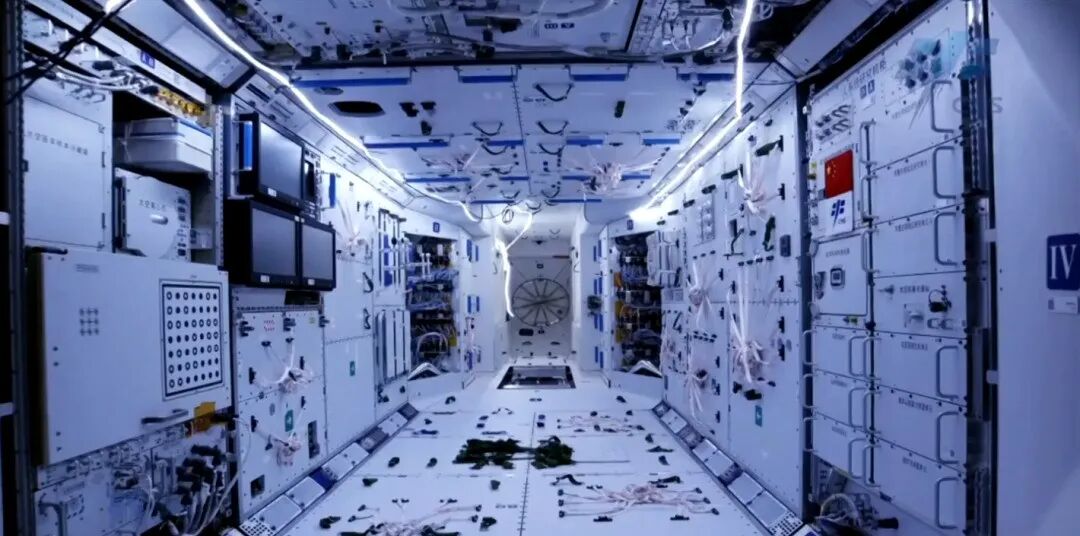
Interior view
From 'sleeping standing up' to 'sleeping lying down'
In space, astronauts can also achieve 'sleep freedom' and enjoy independent sleeping areas to ensure uninterrupted sleep. Although they still have to 'put themselves into sleeping bags,' they have now moved from 'sleeping standing up' to 'sleeping lying down.' Independent sleeping areas allow astronauts to relax more and enjoy relatively high-quality sleep, keeping them full of energy for work and life in space. In line with a 'human-centered' design philosophy, China's space station has separate living and working areas. The living area includes independent sleeping, sanitation, and exercise areas, as well as a space kitchen and dining area. The design takes privacy and convenience into account to the greatest extent, greatly improving astronauts' quality of life in space. Although astronauts cannot enjoy showers and baths like those on Earth, each of them can use a handheld sprayer in an 'enclosed shower cubicle' to wipe themselves clean, addressing personal hygiene as fully as possible.
Astronauts are very busy in space
According to the experience of international peers, a considerable part of astronauts' work in space involves in-cabin assembly and maintenance. That is, to complete the construction of the space station and keep it operating for more than a decade, much assembly and maintenance work needs to be completed independently by astronauts in space, and some of it even requires extravehicular activities outside the cabin. In the core module alone, there are 1,243 pieces of equipment, and much of their assembly work needs to be done manually by astronauts in space. In addition, there is a series of extravehicular activities, so astronauts in space are definitely 'busy bees.'To enable astronauts to complete maintenance and assembly work more accurately and efficiently, designers put considerable effort into 'error-proof design' and came up with many measures. They took steps regarding markings, colors, shapes, and other aspects of the equipment, cables, and connectors to be maintained or assembled, ensuring that astronauts 'do not misidentify or misoperate' during space operations.
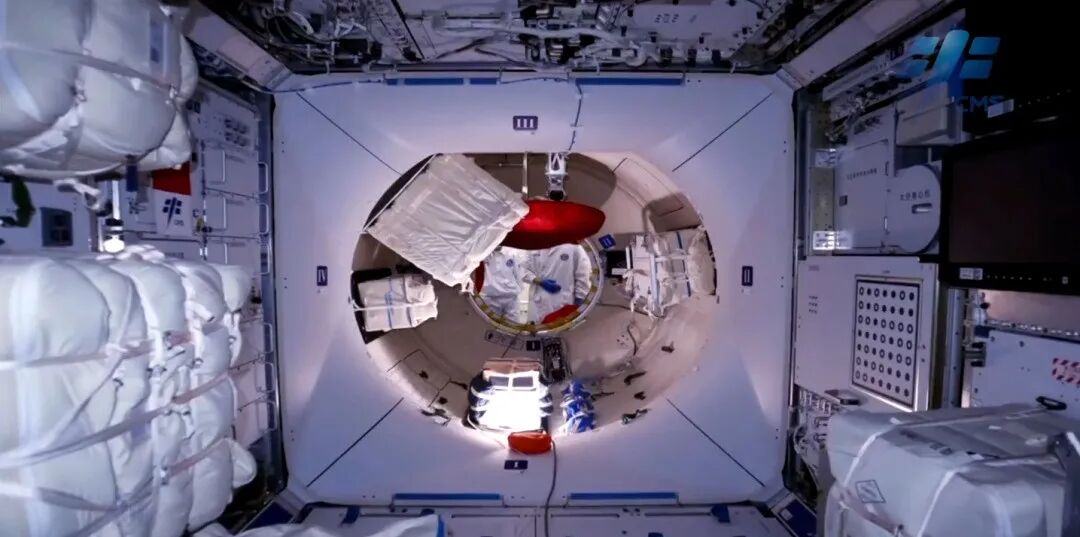
Interior view
There is also an identical space station on the ground
Nothing in space is trivial. Every second of the space station's construction and operation is closely monitored by ground staff. Moreover, there is an identical space station on the ground, precisely so that in emergencies ground personnel can provide strong ground support to astronauts in space based on the actual conditions of the simulated space station.In the space station system development team of the Fifth Academy of China Aerospace Science and Technology Corporation (CASC), a dedicated team is responsible for providing life support for astronauts and creating a safe and comfortable working and living environment in space.To create a livable environment, designers need to imagine themselves as 'astronauts' on the ground, experience life and work in the cabin, and translate their own and the team's feelings into design. Designers repeatedly simulate conditions inside, invite astronauts to experience them on site, and compile operation guides that introduce each operation to astronauts with both illustrations and text.The designers said that a large part of the team members' work is communicating with astronauts and optimizing design details from the perspective of living and working in space.With these thorough contingency plans and various human-centered designs, we believe astronauts will surely have an unforgettable 'space journey' on China's space station, this 'smart space port.' Let us wait and see!
Note: This article is reposted from Global IoT Observer, and it is reposted toconvey more information; the copyright belongs to the original author.
Zhuhai Taixin Semiconductor Co., Ltd.
Zhuhai Taixin Semiconductor Co., Ltd. was founded in 2016 and is a high-tech enterprise integrating integrated circuit design and wireless intelligent communication solutions. We have successively launched long-range, low-power IoT Wi-Fi chips, low-power motor controller chips, and product solutions. The company adheres to a market-oriented and technology-driven approach, providing customers with high-quality chips and product technology solutions.
The company's core product is a Wi-Fi communication chip for long-range, low-power IoT. The chip can be used in product fields such as smart homes, security monitoring, UAV image transmission, smart meter reading, smart door locks, smart grids, smart hospitals, and logistics robots.