
News detail
Industry Watch | What important information did this semiconductor summit at the White House reveal?
On the 12th local time, the U.S. White House hosted a semiconductor conference (via video) to discuss how to solve the current U.S. chip shortage. As is well known, the COVID-19 p…

On the 12th local time, the U.S. White House hosted a semiconductor conference (video conference) to discuss how to solve the current U.S. chip shortage. As is well known, after the COVID-19 pandemic began, “chip shortage” gradually became a global issue.
The heads of 19 related large companies, including Ford, Intel, and Samsung, attended the meeting. The chairman of TSMC was also invited to attend.
At the meeting, Biden still used China to dramatize the sense of urgency,claiming that “China plans to reorient and dominate the semiconductor supply chain,” and that the United States cannot sit idly by.Biden also did not forget his long-cherished $2.3 trillion infrastructure plan, held up a silicon wafer, and stressed, “This is also infrastructure!”
“I have been saying all along that China and the world are not waiting, and there is no reason for the United States to wait,” (China and the rest of the world is not waiting, and there's no reason why Americans should wait.) Biden urged during the public media portion of the meeting, “The United States is now concentrating capital investment in fields such as semiconductors and batteries --this is what others are doing, and we must do it too.” (We're investing aggressively in areas like semiconductors and batteries -- that's what they're doing ... so must we)
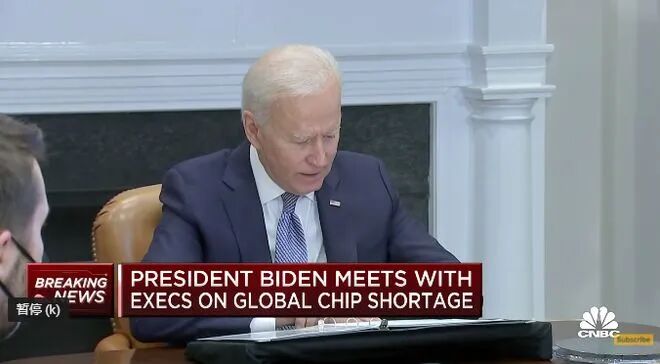
Biden speaking at the meeting (during the public media portion) Video screenshot
The U.S. semiconductor industry once enjoyed a first-mover advantage. After production gradually shifted to Asia and the home country focused on R&D, the supply side is now “held by the throat.” Biden stressed at the meeting,that his $2.3 trillion infrastructure plan will “focus on building semiconductor production (capacity) in the United States.”
“This is also infrastructure,” Biden said as he held up a silicon wafer. “These chips, silicon wafers -- batteries, broadband -- are all infrastructure, all of these are infrastructure.”(These chips, these wafers … batteries, broadband — it’s all infrastructure. )
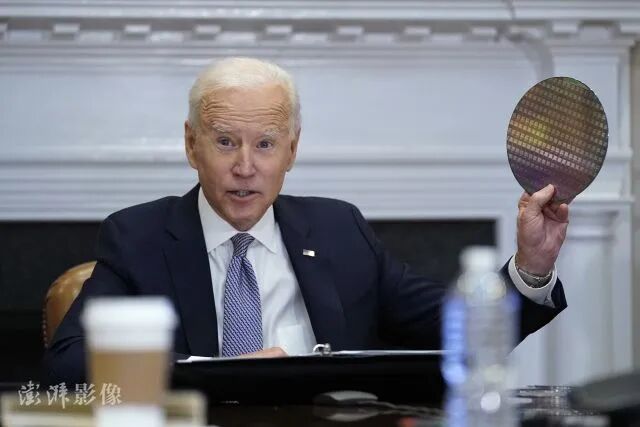
Biden holding a silicon wafer. Image source: Pengpai Imaging, same below
Biden emphasized that he had received a joint letter from 23 senators and 42 representatives today supporting the “CHIPS for America Program.” The letter mentioned that “if we lose to China in these high-skill jobs and expertise, the loss will be irreparable.” The letter also pointed out that “the United States relies on strategic competitors for precision semiconductors, and there are risks in this.”
According to The Wall Street Journal, Biden directly quoted the content of the letter at the meeting, claiming that “China plans to dominate the semiconductor supply chain and is investing considerable funds to achieve its goal.” The letter also urged Biden to cooperate with allies to build its own chip industry,to “take steps more aggressive than China's” (outscale China's aggressive steps).
U.S. National Public Radio (NPR) mentioned that Biden's infrastructure plan has not yet won the support of any Republican lawmakers in either chamber of Congress, and many members of the opposing party criticized the plan as “too broad and limited to traditional infrastructure projects such as roads and bridges.”
But Biden remained confident,He noted that domestic chip manufacturing is a 'bipartisan issue.' 'This is an issue with broad support in the U.S. Senate,' Biden said.
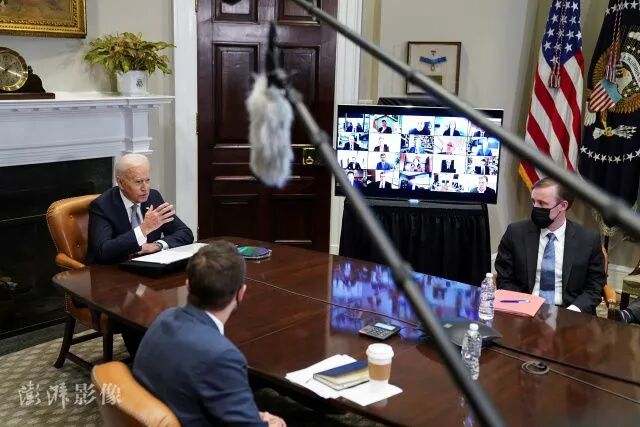
White House venue for the virtual semiconductor meeting
The meeting on the 12th was not only attended by Biden but also hosted by White House National Security Advisor Jake Sullivan, National Economic Council Director Brian Deese, and Commerce Secretary Gina Raimondo.
On the corporate side, senior representatives from automakers hit hardest by the chip shortage—such as Ford, General Motors, and Stellantis—as well as decision-makers from major chip users including Intel, Google parent Alphabet, AT&T, and HP, all attended the meeting.
On the supply side, TSMC Chairman Mark Liu attended.He said in a briefing before the summit that the chip shortage has nothing to do with where manufacturers are located; it is mainly caused by the pandemic prompting supply-chain inventory increases, U.S.-China trade tensions, and the pandemic accelerating digital transformation.
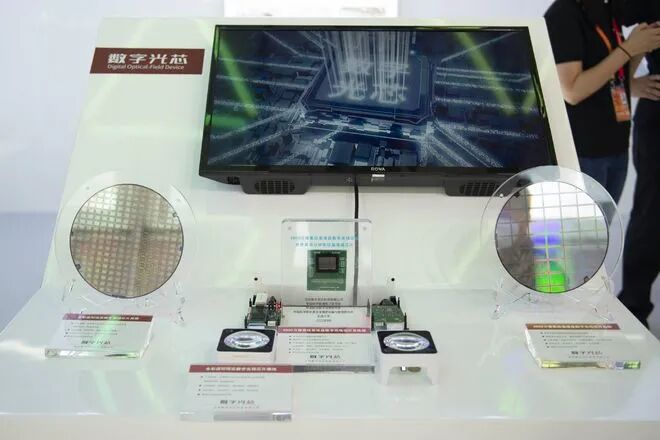
In September 2020, a 48-megapixel silicon-based liquid-crystal digital light-field chip and circuit exhibited at the China International Fair for Trade in Services in Beijing
Participants reportedly welcomed the White House's focus on the chip shortage. 'This is an excellent opportunity for us to discuss long-term solutions to this problem,' said John Neuffer, president of the Semiconductor Industry Association (SIA), at the meeting.
'In 1990, the United States produced 37% of the world's semiconductors; today it produces only 12%,' he said. 'The fragility of the supply chain stood out in bold relief last year.'
National Security Advisor Jake Sullivan said the chip issue 'constitutes a vulnerability in U.S. national security.'
Biden's deputy national security advisor said the Biden administration views the chip shortage as a national security issue. 'For the vast majority of emerging industries, semiconductors are the top priority, along with pharmaceuticals, aerospace, and other fields. The problem is that today, almost 100% of manufacturing is in East Asia, and 90% is produced by one company—this is a serious vulnerability.'
The CFO of Nvidia, the highest-market-cap chip supplier in the United States, said at the meeting, 'Problems on the supply side will continue for several months. Chips will remain in short supply this year.'
Before the meeting, the White House stressed that 'the discussion is also an effort to solve the supply shortage' and said the meeting was not aimed at making any statements or decisions.
After the roughly three-hour meeting, the White House said, 'Participants emphasized increasing transparency in the semiconductor supply chain to help ease the current shortage. They also considered it important to improve demand forecasting across the supply chain to help mitigate future challenges. The meeting also raised the need to build additional semiconductor manufacturing capacity to address the supply shortfall.'
America Has a 'Chip Problem,' and It Is in Mainland China
The production capacity of Samsung and TSMC needs no elaboration. In fact, the U.S. government's recent anxiety over chips is not only because the chip shortage has severely affected multiple industries, but also because of concerns that mainland China is accelerating its catch-up with and overtaking the United States in the semiconductor industry.
In February this year, CNN published an article saying that experts noted that while the U.S. share of global semiconductor manufacturing has declined, mainland China's share has been growing, and the two are now roughly equal. Today, both mainland China and the United States account for about 12% of global semiconductor manufacturing.
On February 11, the Semiconductor Industry Association—composed of leading chip companies such as IBM, Qualcomm, and Intel—also hinted at this in a letter to Biden.
They wrote, 'The decline in manufacturing share is largely because governments in countries where our competitors are located have offered large-scale subsidies and incentives to attract new semiconductor manufacturers, while the United States has not.'
In fact, after entering the 21st century, most chip manufacturing has concentrated in Asia. According to Ning Nanshan's 'China's Semiconductor Position in the Global Landscape from a Data Perspective,' published at the end of last year, from 2015 to 2019, mainland China's global share of wafer capacity increased from 9.7% to 13.9%, up 4.2 percentage points. In 2019, it ranked fourth globally, after Taiwan, China, South Korea, and Japan, and surpassed the United States, which accounted for 12.8%. The article noted that mainland China's chip capacity has in fact surpassed that of the United States, but the reason is that much of mainland China's capacity belongs to foreign-funded factories.
It must be mentioned that in the field of chip design alone, the United States remains far ahead. This is also an area where China is making efforts. Ning Nanshan introduced that in terms of the share of pure chip design companies, in 2019 the United States (companies) accounted for 65% of the world, almost twice the total of all other regions combined. Qualcomm, Broadcom, NVIDIA and AMD still lead in chip design.
Incidentally, automakers are a “hardest-hit area” of the chip shortage. Several automaker representatives attended this White House semiconductor meeting.
But according to CNBC, U.S. officials previously pointed out that the automotive industry accounts for only 5% or even less of global chip use. As a result, they are a low priority for chip suppliers. This is very likely why they are the first to be affected in a shortage environment. In addition, the chips used by the automotive industry are far from the most advanced products, and the supply side is not highly motivated in R&D and production.
On April 2, Germany’s Handelsblatt published an article stating, “In the chip competition, China is by no means powerless.”
The report said that although the United States is trying to force China to yield by restricting semiconductor exports to China, this goal will be difficult to achieve. Handelsblatt further called on the Biden administration to abandon this confrontational approach and engage in dialogue with China, because the relevant U.S. industries have paid a high price.
In addition, the article also believes that the United States’ “stranglehold” on China in the chip field will not only fail to force the Chinese mainland to yield, but will also continuously spur the Chinese mainland to build its own competitive semiconductor industry. Although this process takes time, in the fields of solar energy, trains and automobiles, the Chinese mainland has proven that it is fully capable of catching up.
Note: This article is reposted fromGuancha.cn Author: Ju Feng, reposted thisarticle is intended to convey more information; the copyright belongs to the original author.

Zhuhai Taixin Semiconductor Co., Ltd.
Founded in 2016, Zhuhai Taixin Semiconductor Co., Ltd. is a high-tech enterprise integrating integrated circuit design and wireless intelligent communication solutions. We have successively launched long-range low-power long-range IoT Wi-Fi chips, low-power motor controller chips and product solutions. The company adheres to being market-oriented and technology-centered, providing customers with high-quality chips and product technical solutions.
The company’s core product: a long-range, low-power IoT Wi-Fi communication chip. The chip can be used in product fields such as smart homes, security monitoring, UAV image transmission, smart meter reading, smart door locks, smart grids, smart hospitals, and logistics robots.