To meet growing demand during the current global chip shortage, the semiconductor industry is significantly increasing its fab capacity utilization, a term that refers to the perc…
To meet growing demand during the current global chip shortage, the semiconductor industry is significantly increasing its fab capacity utilization—the percentage of total available manufacturing capacity used at any given time. However, increasing semiconductor capacity utilization takes time. It is not as easy as flipping a switch and increasing chip output overnight.When market demand is high—for example, during cyclical upturns such as the current one—capacity utilization at front-end semiconductor manufacturing facilities or fabs typically exceeds 80%, and utilization at some individual fabs may reach as high as 90–100%. As shown in the table below, the industry has been steadily increasing overall fab utilization over the past two years, and utilization is estimated to rise further through most of 2021 to meet demand. Higher fab utilization will increase chip output and enable the entire industry to fully meet growing market demand.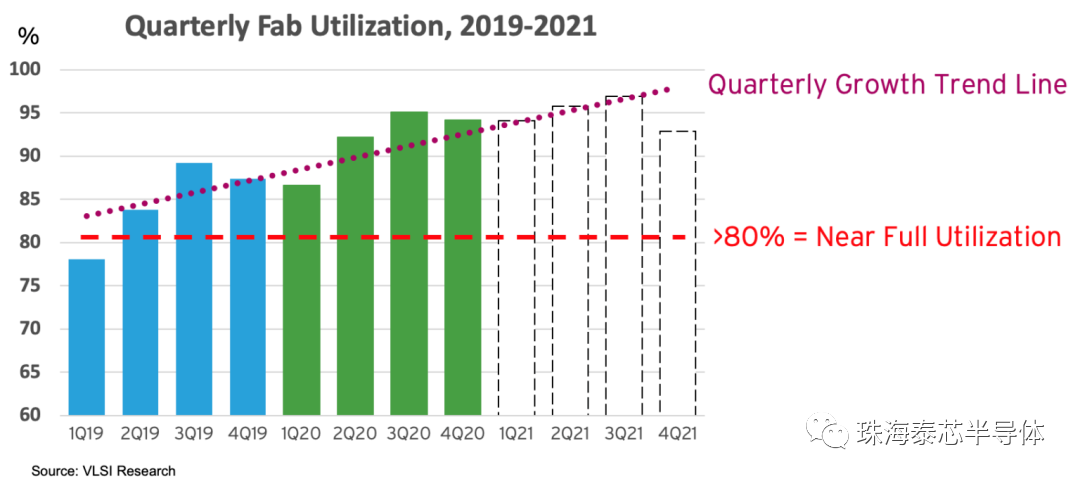
Unfortunately, increasing semiconductor capacity utilization takes time because semiconductor production is extremely complex. The process of manufacturing a chip is highly complex and requires highly specialized inputs and equipment to achieve the required precision at microscopic scale. The overall manufacturing of a semiconductor silicon wafer alone can involve as many as 1,400 process steps (depending on the complexity of the process). Each process step typically also involves the use of various highly complex tools and machines. In short, manufacturing semiconductors is very difficult, and therefore takes time.So how long does it take to manufacture chips for customers? Research shows that it can take up to 26 weeks for a fab to manufacture finished chips for customers. The main reasons are as follows: the cycle time to manufacture completed semiconductor wafers averages about 12 weeks, while advanced processes may take 14–20 weeks. It takes additional time—about 24 weeks—to refine the chip manufacturing process to improve yields and output.Then, once the manufacturing process is complete, the semiconductors on the silicon wafer must go through the final production stage, called back-end assembly, testing, and packaging (ATP), before the chips are finally finished and ready for delivery to the end customer. ATP can take another 6 weeks to complete. Therefore, the lead time from when a customer places an order to when the final product is received can be up to 26 weeks. The table below provides some of the average times required in the chip manufacturing process.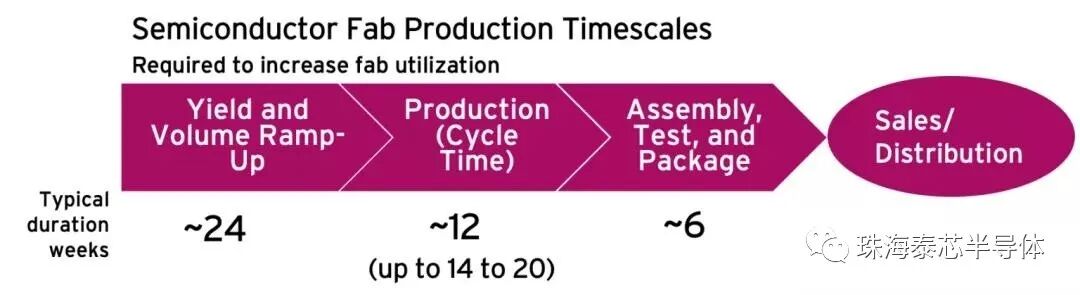
This ultimately means that the semiconductor industry is currently doing everything it can in the short term to increase utilization and meet the growing demand of the automotive industry and all customers. Forcing the industry to pick winners and losers by deciding who gets chips and who does not will not overcome the time constants involved in manufacturing semiconductors described above.The semiconductor industry has extensive experience in complex supply chains and can successfully address the challenges of the current demand environment. For example, in addition to increasing utilization, improving yields, and boosting output, semiconductor companies have established command centers to assist with the most urgent customer requests and are working closely with customers to ensure they do not double-order. These strategies help deliver products to customers as quickly and efficiently as possible during this challenging period.In the long run, total global fab capacity will ultimately need to increase to meet long-term growth in chip demand that cannot be met by raising utilization alone. Therefore, the global semiconductor industry is planning record levels of investment in manufacturing and R&D to meet this expected market growth in the coming years.This article is reposted from Semiconductor Industry Watch (ID: icbank) and compiled from SIA.
Zhuhai Taixin Semiconductor Co., Ltd.
Founded in 2016, Zhuhai Taixin Semiconductor Co., Ltd. is a high-tech enterprise integrating IC design and wireless intelligent communication solutions. We have successively launched long-range low-power IoT Wi-Fi chips, low-power motor controller chips, and product solutions. The company adheres to a market-oriented and technology-centered approach to provide customers with high-quality chips and product technical solutions.
The company's core product: a Wi-Fi communication chip for long-range low-power IoT. This chip can be used in smart home, security surveillance, UAV image transmission, smart meter reading, smart locks, smart grid, smart hospitals, logistics robots, and other product fields.