
News detail
Industry Observation | Understanding the Current Status and Trends of the WiFi Industry in One Article
This article is republished from “Yushi Capital.” WiFi Industry Market Overview. WiFi technology features short-range transmission and high speed, and was first adopted at scale i…
This article is republished from“Yushi Capital”
WiFi Industry Market Overview
WiFi technology features short-range transmission and high speed, and was first adopted at scale in consumer electronic terminal devices such as mobile phones and laptops, while gradually penetrating application scenarios such as the Internet of Things and virtual reality.
Definition of WiFi Technology
WiFi (Wireless Fidelity) is a local area network communication technology that wirelessly connects electronic terminal devices to one another. WiFi technology is based on the IEEE 802.11 standard, a wireless local area network communication standard defined by the Institute of Electrical and Electronics Engineers (IEEE). By defining a media access control (MAC) layer and several physical layer (PHY) specifications, it establishes wireless local area network connections for portable and mobile terminal devices.
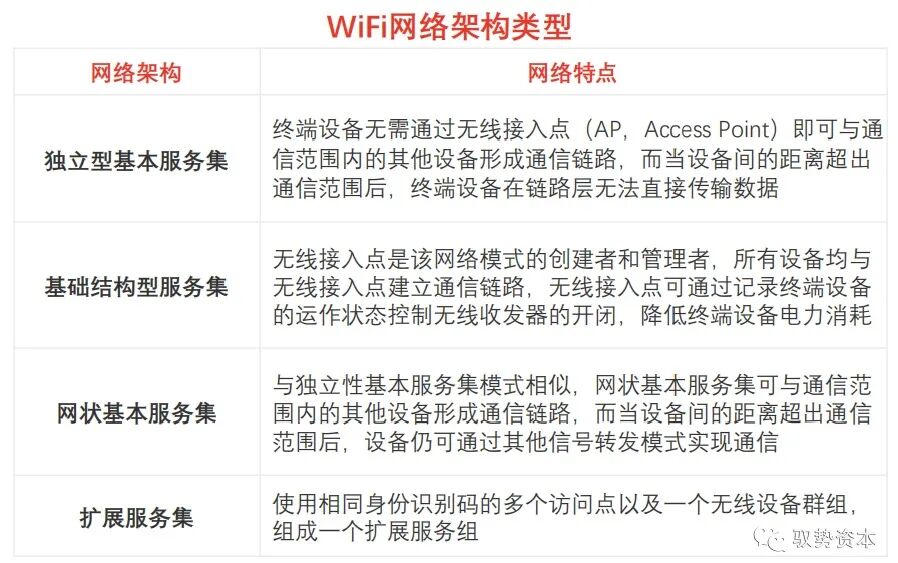
According to the definition of the IEEE 802.11 standard, WiFi network architecture can be divided into Independent Basic Service Set (IBSS), Infrastructure Basic Service Set (BSS), Mesh Basic Service Set (MBSS), and Extended Service Set (ESS). WiFi technology features short-range transmission and high speed, and was first adopted at scale in consumer electronic terminal devices such as mobile phones and laptops, while gradually penetrating application scenarios such as the Internet of Things and virtual reality.
Wireless Transmission Technologies for the Internet of Things
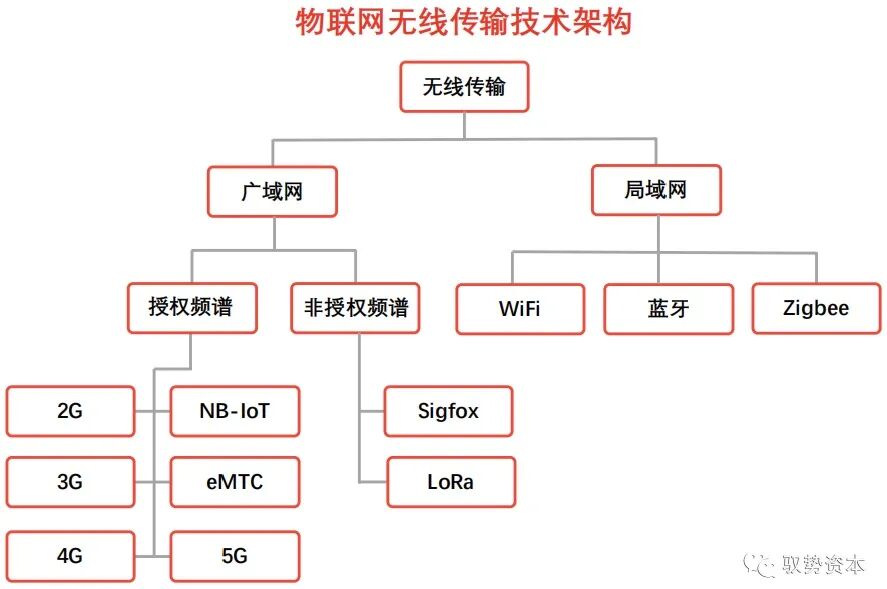
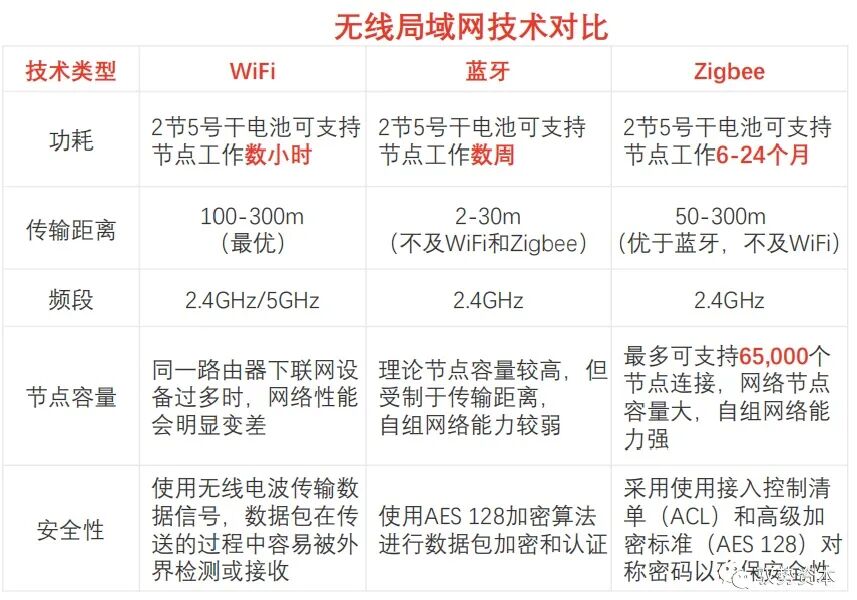
In the IoT communications technology system, WiFi, Bluetooth, and Zigbee all belong to wireless local area network technologies and primarily target scenarios with a relatively small communication range. These three types of technology differ in transmission rate, transmission distance, power consumption, and other aspects.
The Internet of Things has a four-layer architecture: perception layer, transmission layer, platform layer, and application layer. Among these, the transmission layer uses various network communication technologies to transmit information identified and collected by the perception layer. Network communication technologies at the IoT transmission layer can be divided into wireless transmission and wired transmission technologies. At present, wireless transmission technology is the mainstream network communication technology in the IoT field. Wireless transmission technologies can be further divided into wide area network technologies and local area network technologies, and wide area network technologies can also be divided into licensed spectrum technologies and unlicensed spectrum technologies. Compared with wireless wide area network technologies, wireless local area network technologies have shorter transmission distances and smaller communication ranges. At present, wireless local area network technologies applied in the IoT field mainly include WiFi, Bluetooth, and Zigbee, and these three types of technology differ in transmission rate, transmission distance, power consumption, and other aspects.
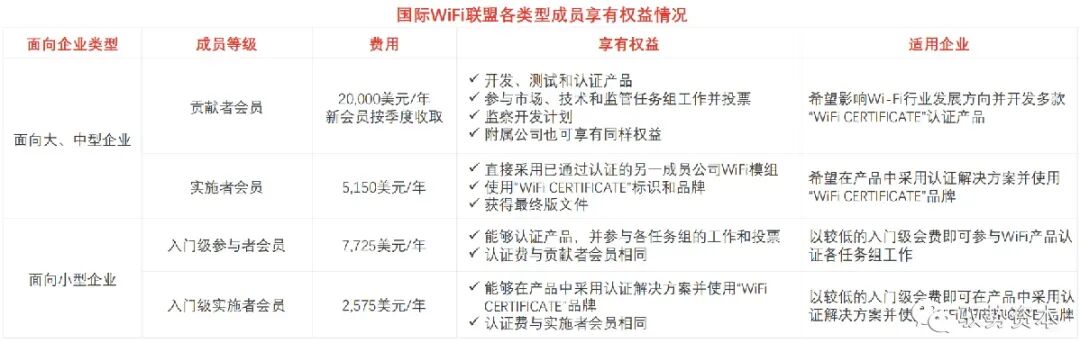
Introduction to the Wi-Fi Alliance
The Wi-Fi Alliance sets four membership levels according to the different product certification needs of various enterprises; members at different levels pay different fees and enjoy different rights and benefits.
International WiFi Alliance: The WiFi Alliance (WFA), founded in 1999, is an international organization responsible for certification of WiFi technology application products and trademark licensing. The Institute of Electrical and Electronics Engineers (IEEE) created the IEEE 802.11 standard for WiFi technology but is not responsible for testing or certifying related technical products. The WiFi Alliance fills the gap in technology certification. By establishing and enforcing certification standards for WiFi-related products, it tests and verifies the interoperability and compatibility of technology-related products, thereby further promoting the standardized application of WiFi technology. After related technical products pass WiFi Alliance testing, the relevant manufacturers and distributors of the products are authorized to use the “WiFi CERTIFICATE” trademark on their products. The WiFi Alliance sets four membership levels according to the different product certification needs of various enterprises. Members at different levels pay different fees and enjoy different rights and benefits. Among them, membership levels for large and medium-sized enterprises include Contributor Members and Implementer Members, while membership levels for small enterprises include Entry-Level Participant Members and Entry-Level Implementer Members.
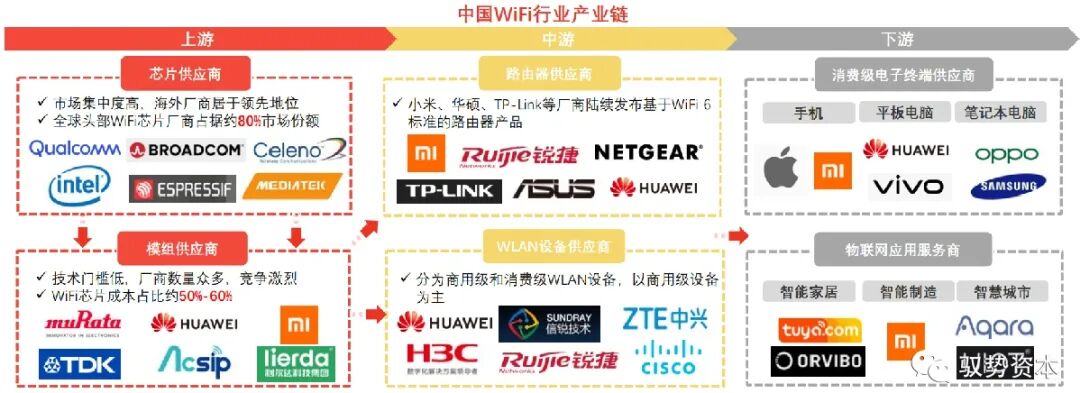
Analysis of the WiFi Industry Value Chain
In China’s discrete device field, 8-inch wafer processes lag behind the international leading level overall, and this constrains the development of China’s small-signal discrete device design capabilities. China’s WiFi industry value chain includes upstream chip suppliers and module suppliers, midstream router suppliers and WLAN equipment suppliers, and downstream consumer electronic terminal suppliers and IoT application service providers.
China’s WiFi Industry Value Chain
China’s WiFi industry value chain includes upstream chip suppliers and module suppliers, midstream router suppliers and WLAN equipment suppliers, and downstream consumer electronic terminal suppliers and IoT application service providers. Upstream chip suppliers provide WiFi chip products to module suppliers, and module suppliers provide communication equipment module products to midstream router suppliers and WLAN equipment suppliers. Midstream router suppliers and WLAN equipment suppliers provide downstream customers with wireless network equipment products such as routers and WLAN equipment. Downstream consumer electronic terminal suppliers and IoT application service providers provide end users with terminal products and application services based on WiFi technology.
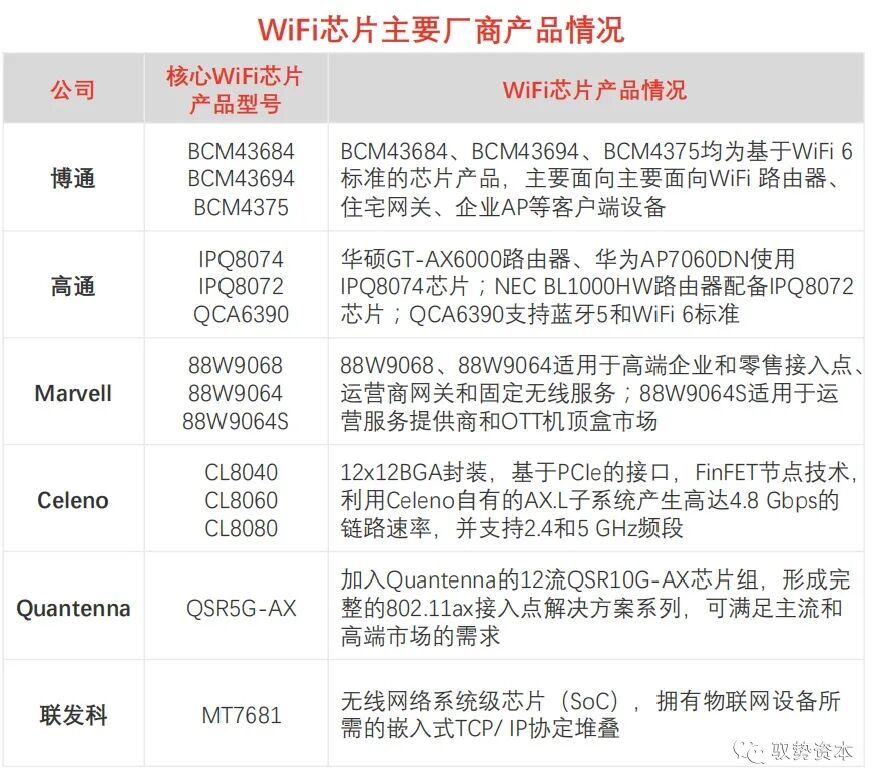
Upstream Value Chain Analysis
The WiFi chip market is highly concentrated, with large overseas traditional integrated circuit design manufacturers occupying a dominant position. With the promotion of the WiFi 6 standard, leading manufacturers are gradually accelerating the promotion of WiFi 6 chip products.
WiFi Chip Market Status: The WiFi chip market is highly concentrated and dominated by overseas manufacturers. Leading manufacturers such as Broadcom, Qualcomm, Marvell, Celeno, and Quantenna account for about 80% of the market share.
WiFi Chip Market Prices: WiFi chips can be divided into terminal device chips and network device chips. Among them, the average unit price range of terminal device chips is approximately RMB 5–10, and the average unit price range of network device chips is approximately RMB 20–30.
WiFi Chip Market Participants: Participants in the WiFi chip market include large traditional integrated circuit design manufacturers represented by Broadcom, Qualcomm, Marvell, Celeno, and MediaTek, as well as small and medium-sized integrated circuit design enterprises represented by Espressif Systems, Southern Silicon Valley, Lianshengde, and Nufront.
WiFi Chip Market Frontier: WiFi 6 is the latest WiFi technology standard. Leading WiFi chip manufacturers such as Broadcom, Qualcomm, and Marvell are gradually accelerating the promotion of WiFi 6 chip products. In 2019, there were multiple acquisitions of chip manufacturers in the WiFi chip market. Leading traditional integrated circuit manufacturers entered the upstream WiFi industry chain market by acquiring WiFi chip-related manufacturers, laying the groundwork for their strategic deployment in the IoT application market.

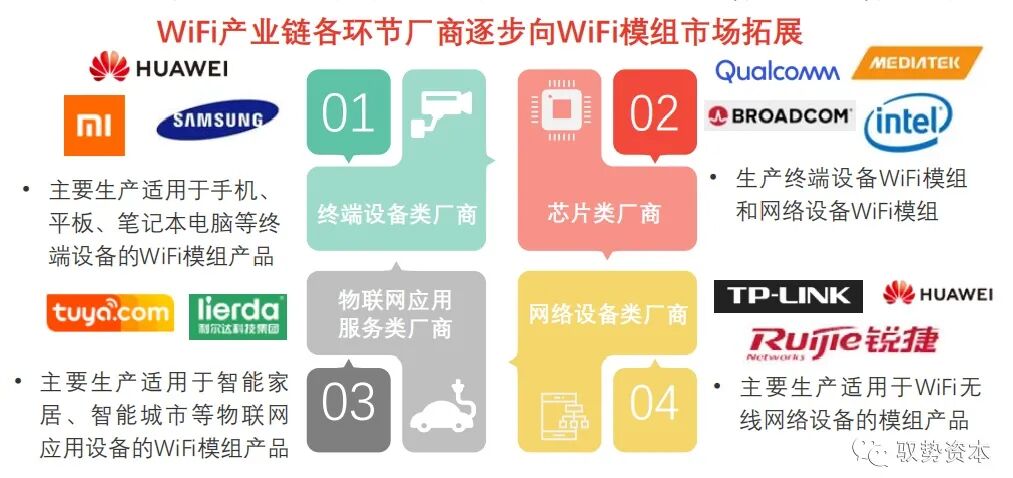
Manufacturers at various links of the WiFi value chain are gradually expanding into the WiFi module market. According to the application characteristics of module products, WiFi module manufacturers can be divided into terminal device manufacturers, chip manufacturers, IoT application service providers, and network equipment manufacturers.
WiFi Module Market Status: Compared with WiFi chips, WiFi modules have lower production barriers, a large number of manufacturers, and more intense market competition. Manufacturers at various links of the WiFi value chain are gradually expanding into the WiFi module market.
WiFi Module Market Prices: WiFi modules can be divided into terminal device modules and network device modules. Among them, the average unit price range of network device modules is approximately RMB 40–60. The prices of WiFi module products used in different types of terminal devices vary. Among them, the average unit price range of WiFi modules for mobile phones is approximately RMB 5–20, and the average unit price range of WiFi modules for smart home terminal devices is approximately RMB 15–45.
WiFi Module Market Participants: According to the application characteristics of module products, WiFi module manufacturers can be divided into terminal device manufacturers, chip manufacturers, IoT application service providers, and network equipment manufacturers. Typical representatives of terminal device manufacturers include Huawei, Xiaomi, and Samsung; typical representatives of chip manufacturers include Qualcomm, Broadcom, and MediaTek; IoT application service providers include Tuya Smart and Lierda; and network equipment manufacturers include Ruijie Networks, Huawei, and TP-Link.
WiFi Module Market Development: At this stage, compared with WiFi modules for mobile phones, WiFi modules used in IoT scenarios such as smart homes and smart cities are still at a relatively high price level and still have considerable room for decline.
Midstream Industry Chain Analysis
Multiple vendors have launched router products supporting the WiFi 6 standard; these products are priced high, mainly target gaming scenarios, and offer wireless speeds of over 3,000Mbps.
WiFi Routers: Important Equipment for Signal Transmission
WiFi routers can convert wired network signals into wireless network signals, providing signal transmission functions for terminal devices such as mobile phones, laptops, and smart home appliances equipped with WiFi modules. In the Chinese market, representative WiFi router vendors include TP-Link, Huawei, Xiaomi, ASUS, and Netgear.
Multiple Vendors Release WiFi 6 Router Products
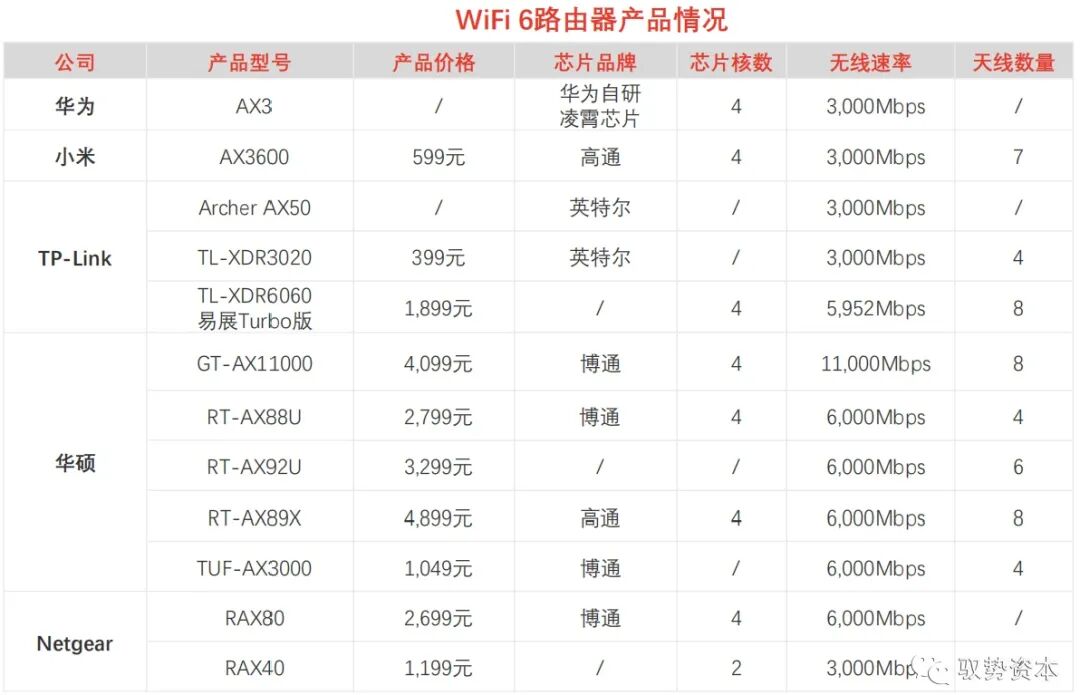
As the application and promotion of the WiFi 6 technical standard gradually accelerate, multiple router vendors such as TP-Link, Huawei, Xiaomi, ASUS, and Netgear have launched router products supporting the WiFi 6 standard to meet market development needs. From the perspective of product development, current WiFi 6-related router products are priced high, mostly use 4-core chips, mainly target gaming scenarios, and all have wireless speeds above 3,000Mbps. Among them, the ASUS GT-AX11000 can reach speeds above 11,000Mbps. As the application scale of WiFi 6 routers further expands, related product prices will trend downward.
The current WLAN equipment market is dominated by commercial-grade products and is highly concentrated. Leading WLAN equipment vendors such as H3C, Ruijie Networks, and Huawei have successively launched WLAN equipment based on the WiFi 6 standard, making market competition increasingly intense.
WLAN Equipment: WLAN (Wireless Local Area Network) refers to a local area network system that uses radio waves as the data transmission medium to connect computer devices and enable resource sharing. Equipment constituting a WLAN network includes WLAN terminal devices, APs (Access Points), ACs (Access Controllers), and PORTAL servers.
WLAN Equipment Products and Application Services: WLAN equipment vendors mainly provide users with AP and AC equipment and can also provide overall WLAN network solutions. WLAN equipment products and application services can be divided into commercial-grade and consumer-grade levels. At present, the WLAN equipment market is dominated by commercial-grade products, mainly targeting large-scale application scenarios such as industrial parks, airports, and railway stations.
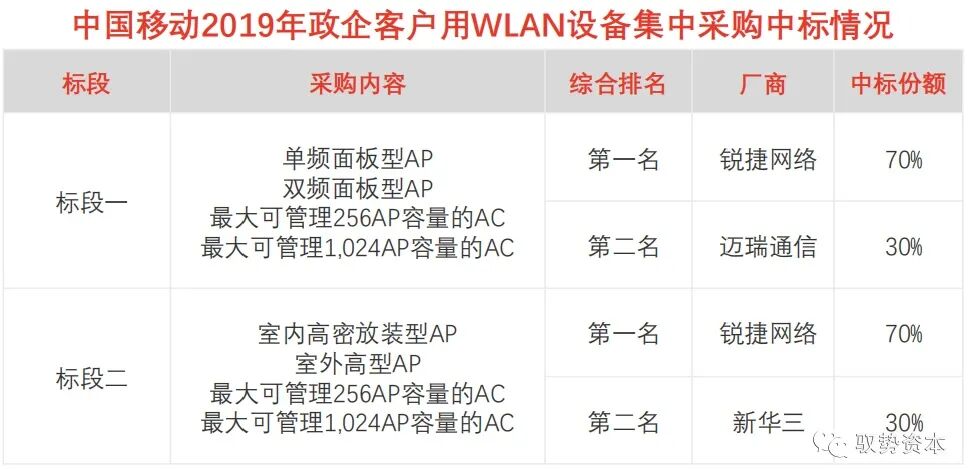
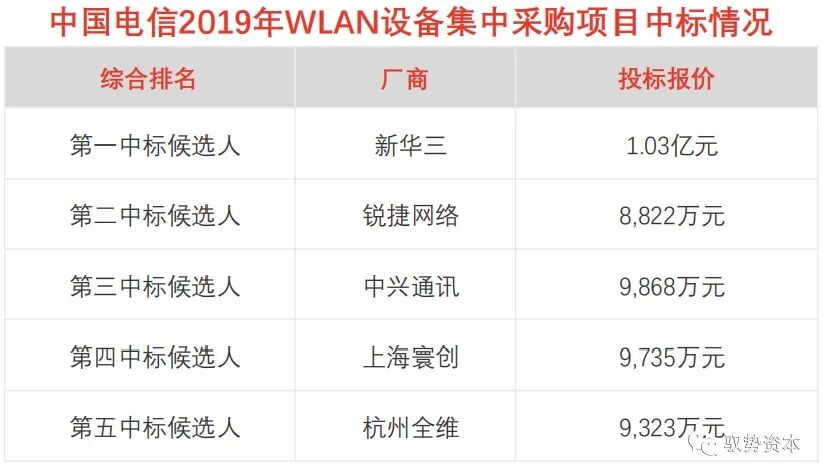
Competitive Landscape of the WLAN Equipment Market: The WLAN equipment market is highly concentrated. Cisco, Aruba-HPE, Ubiquiti, ARRIS, and Huawei account for about 80% of the global market, while in the Chinese market, H3C, Ruijie Networks, Huawei, Sundray Technology, and Cisco together account for about 90% of the market share. In Chinese telecommunications operators' large-scale centralized procurement projects for WLAN equipment in 2019, Ruijie Networks and H3C won bids multiple times.
Frontiers in WLAN Equipment Market Development: Leading WLAN equipment vendors such as H3C, Ruijie Networks, and Huawei have successively launched WLAN equipment based on the WiFi 6 standard, such as Ruijie Networks' RG-AP880 and Huawei's AirEngine series. Competition among leading vendors in WiFi 6 WLAN equipment will become increasingly intense, and the WLAN equipment market will maintain a highly concentrated development trend.
Downstream Industry Chain Analysis
Consumer electronic terminals are a core application scenario for WiFi technology, but over the past five years, the market size of consumer electronic terminals represented by smartphones has gradually declined, and WiFi technology has been gradually penetrating IoT application scenarios.
Consumer Electronic Terminals Are a Core Application Scenario for WiFi Technology
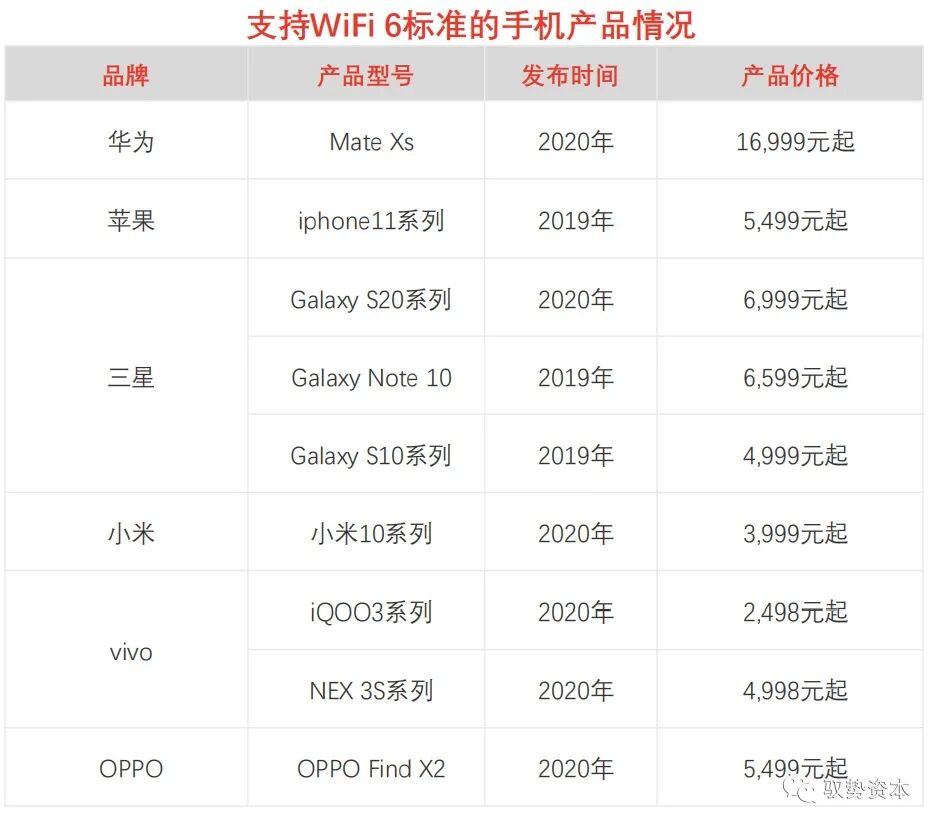
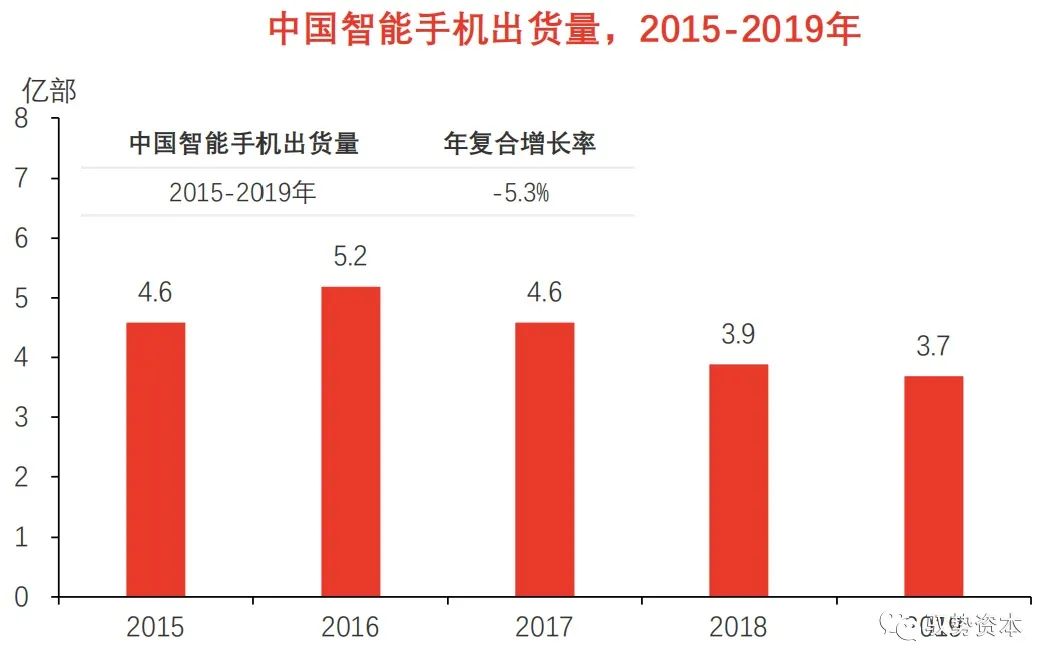
Consumer electronic terminals such as mobile phones, tablets, and laptops are core application scenarios for WiFi technology. Driven by the development of the consumer electronic terminal market, the foundation of the WiFi industry has been gradually established. At present, most smartphones, tablets, and laptops on the market support WiFi technology, and about 50% of WiFi-connected devices are smartphones. Over the past five years, China's smartphone shipments fell from 460 million units in 2015 to 370 million units in 2019, showing a clear downward trend and adversely affecting the WiFi industry. As the WiFi 6 standard is gradually promoted, smartphone vendors such as Apple, Huawei, Samsung, Xiaomi, vivo, and OPPO are gradually accelerating the deployment of WiFi 6-related products to gain development advantages in the increasingly competitive smartphone market.
WiFi Technology Is Focusing on Penetrating IoT Application Scenarios
Over the past five years, as the market size of consumer electronic terminals has gradually declined, WiFi technology has gradually expanded its application market and penetrated IoT application scenarios such as smart homes, smart cities, and smart manufacturing. Among them, the application and promotion of WiFi technology in smart home scenarios has been relatively fast. WiFi technology features short-distance transmission and high speed, which can meet the application needs of smart home scenarios. In addition to WiFi, local area network technologies such as Bluetooth and Zigbee are also commonly used wireless transmission technologies in smart home scenarios, and there is competition among the three technologies. In the Chinese market, typical IoT application service providers based on WiFi technology include Xiaomi, ORVIBO, Tuya Smart, and Unisplendour IoT.
Market Size
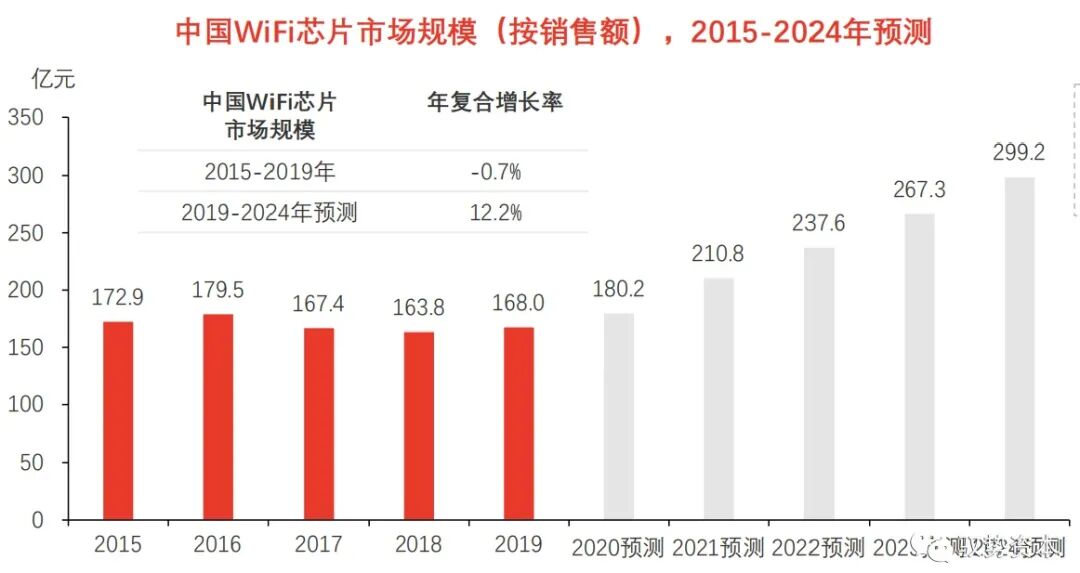
Over the past five years, as the development pace of the consumer electronic terminal equipment market has slowed, the size of China's WiFi chip market has declined somewhat. It is expected that in the next five years, the WiFi 6 standard and IoT applications will drive further growth in the WiFi chip market.
China WiFi Chip Market Size
At present, WiFi technology is still mainly used in traditional consumer electronic terminal equipment such as mobile phones, tablets, and laptops, and the WiFi chip market is closely linked to the consumer electronic terminal market. Over the past five years, the market size of consumer electronic terminal equipment has shown a downward trend. Taking mobile phones as an example, China's mobile phone shipments reached their peak in the past five years in 2016, while from 2017 to 2019, China's mobile phone shipments declined year by year, adversely affecting the WiFi chip market. Calculated by chip sales, the size of China's WiFi chip market fell from RMB 17.29 billion in 2015 to RMB 16.80 billion in 2019. Over the past two years, demand for WiFi chip products in IoT fields such as smart homes and smart cities has increasingly risen, and China's WiFi chip shipments have rebounded somewhat.
Future Development of the WiFi Chip Market
WiFi 6 chip products will become mainstream: At present, shipments of chip products supporting the WiFi 6 standard are still not high, but as the WiFi 6 standard is gradually applied and promoted, it is expected that by 2023, chips supporting the WiFi 6 standard are expected to account for 90% of total WiFi chip shipments.
The share of IoT applications will gradually increase: As shipments of consumer electronic terminals such as mobile phones, tablets, and laptops gradually decline, WiFi technology will accelerate its penetration into IoT application scenarios such as smart homes and smart manufacturing, and the application share of related chips will gradually increase.
New application scenarios will increasingly emerge: In addition to traditional consumer electronic terminals and IoT applications, WiFi technology also has high applicability in new high-speed application scenarios such as VR/AR and ultra-high-definition video. It is expected that WiFi chips for such applications will continue to increase over the next five years.
Drivers of WiFi Industry Development
The WiFi 6 Standard Drives Technological Upgrades
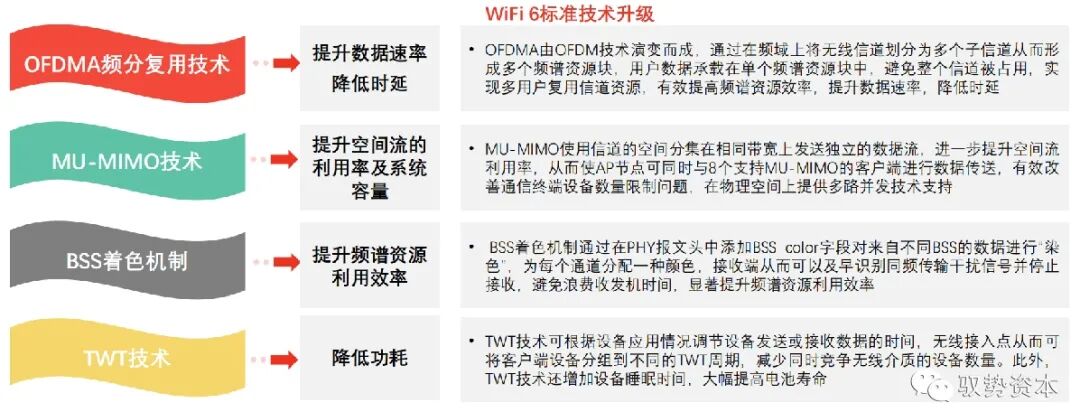
The WiFi 6 standard achieves upgraded development by introducing technologies such as OFDMA frequency-division multiplexing technology, MU-MIMO technology, the BSS coloring mechanism, and TWT technology.
WiFi technology undergoes an iterative upgrade every 4-5 years, and the latest WiFi 6 standard was introduced to the market in 2018. In the WiFi 6 standard, OFDMA frequency-division multiplexing technology and MU-MIMO technology provide multi-channel concurrency support in frequency space and physical space, respectively, significantly improving overall network performance and speed, reducing network latency, and optimizing user experience. The BSS coloring mechanism can reduce co-channel interference and effectively improve the efficiency of spectrum resource utilization. The WiFi 6 standard also introduces TWT technology to reduce the power consumption of terminal devices, which is conducive to further application and promotion of WiFi technology in the IoT field.
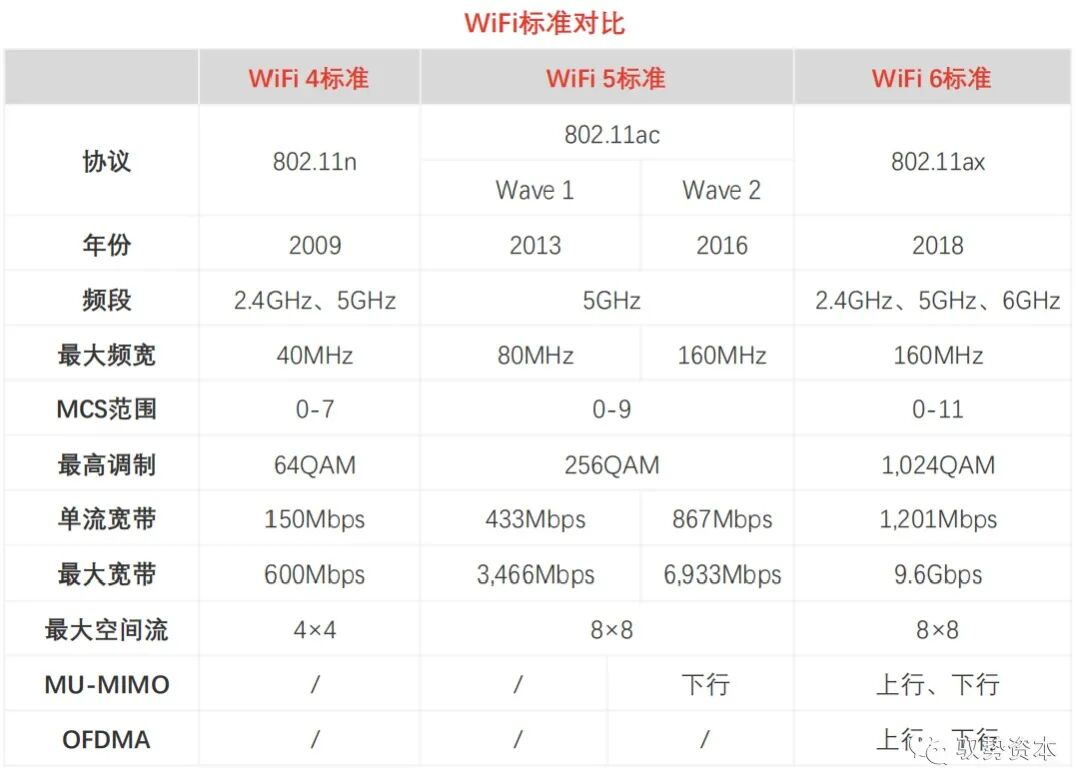
Based on the multi-faceted performance upgrades of the WiFi 6 standard, market demand for products supporting the WiFi 6 standard, such as chips, modules, routers, wireless APs, and mobile phone terminals, is increasingly rising. The WiFi 6 standard will drive further development of the WiFi industry.
The WiFi 6 standard achieves performance improvements in multiple aspects: Compared with previous generations such as WiFi 4 and WiFi 5, the WiFi 6 standard improves bandwidth, the number of connected devices, latency, power consumption, and other aspects. The highest WiFi modulation has been raised from 256QAM in WiFi 5 to 1,024QAM in WiFi 6, enabling high-speed, low-latency network transmission in high-density user environments. In addition, the WiFi 6 standard increases the carrier transmission time per frequency band from 3.2 ms in WiFi 5 to 12.8 ms, effectively reducing packet loss and retransmission rates.
WiFi 6 standard-related products continue to increase: Since the release of the WiFi 6 standard, the number of WiFi 6 standard-related products on the market has continued to increase, which is conducive to the further development of the industry. Based on market product analysis, WiFi 6 standard-related products are mainly concentrated in chips, modules, routers, wireless APs, mobile phone terminals, and other areas, among which wireless APs and mobile phone terminals have developed most prominently. In wireless APs, vendors such as Huawei, Ruijie Networks, and H3C are leading, while in mobile phone terminals, major smartphone manufacturers such as Apple, Huawei, Samsung, and Xiaomi are increasingly fiercely competing in WiFi 6 mobile phone products.
Rapid expansion of the smart home application market
WiFi is an important wireless networking connectivity technology in smart home scenarios. Against the backdrop of rapid expansion in the smart home application market, the development pace of the WiFi technology industry is accelerating.
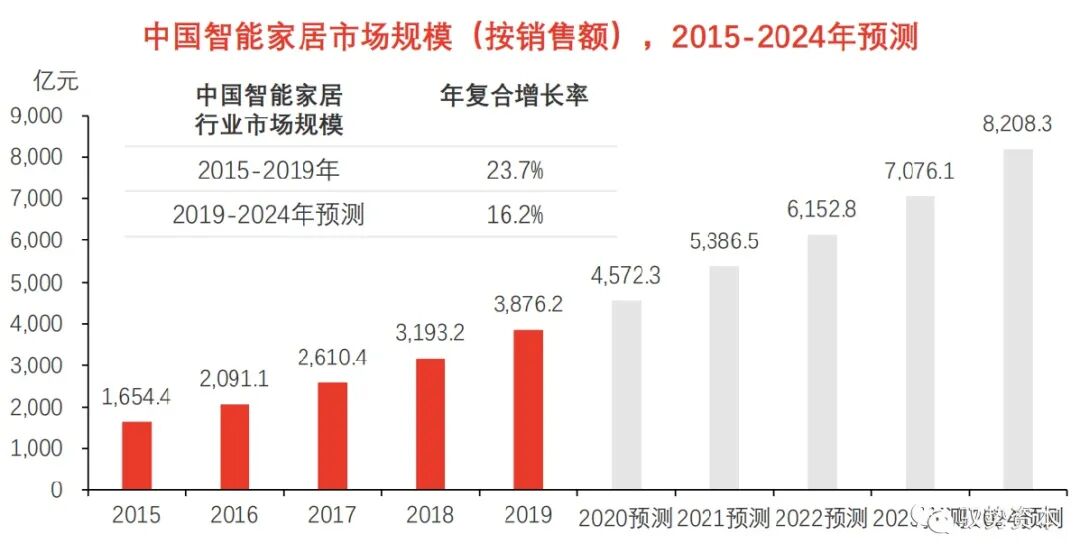
China's smart home market is expanding rapidly: Empowered by intelligent technologies such as artificial intelligence, the Internet of Things, cloud computing, and big data, the smart home industry is developing rapidly, and the number of related products is growing swiftly. In addition, as the per capita disposable income of Chinese residents continues to rise, consumers' spending capacity for smart home products is also constantly improving, driving the gradual expansion of China's smart home market. The market size of China's smart home market grew from RMB 165.44 billion in 2015 to RMB 387.62 billion in 2019, with a compound annual growth rate of 23.7%. It is predicted that in the next five years, consumer awareness of smart homes will continue to increase, the penetration of smart home products will gradually rise, and the smart home market size will further expand.
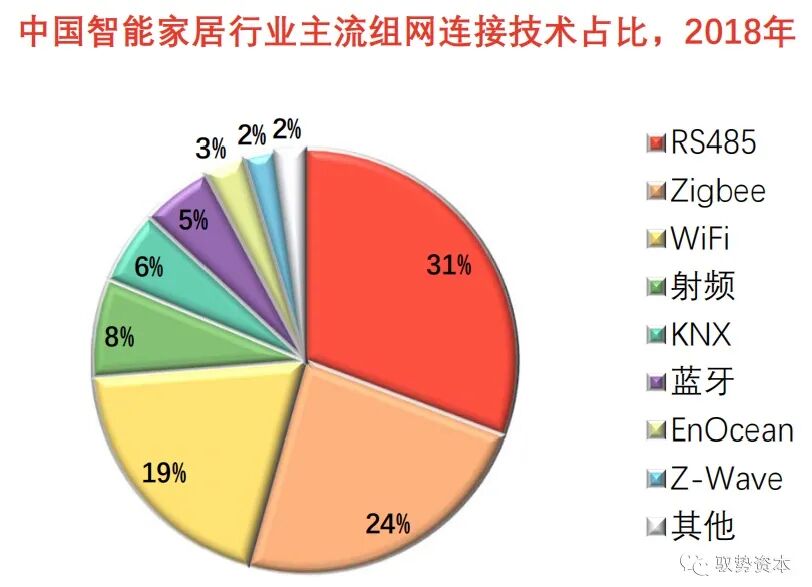
WiFi is an important wireless networking connectivity technology in smart home scenarios: WiFi technology has outstanding advantages such as high speed, high bandwidth, and safety and reliability, and can meet the application needs of smart homes. It is an important wireless networking connectivity technology in smart home scenarios. According to data from the China Smart Home Industry Alliance, in 2018, WiFi accounted for 19.4% of applications in the networking connectivity technology system of China's smart home industry, making it the second-largest wireless transmission technology in smart home scenarios. Thanks to the rapid development of China's smart home market, the number of smart home devices using WiFi technology continues to grow, and the development pace of the WiFi industry is accelerating.
Risk factors in the development of China's WiFi industry
Risks in the development of China's WiFi industry are mainly reflected on the demand side and the technology application side: On the demand side, the declining trend in smartphone shipments is detrimental to the development of the WiFi industry; on the technology application side, WiFi faces competitive risks from other IoT communication technologies.
Demand-side risk: smartphone shipments tend to decline
Consumer electronic terminals such as mobile phones, tablet computers, and notebook computers are the core application market for WiFi technology, among which about 50% of WiFi-connected devices are smartphones. China's smartphone shipments gradually declined after reaching a peak in the past five years in 2016, falling from 520 million units in 2016 to 370 million units in 2019, showing an obvious downward trend. As the core representative of downstream application demand, the gradual contraction of the smartphone market brings significant development risks to the upstream and midstream of the WiFi industry chain, increasing pressure on industry development.
Technology application-side risk: competitive risks from other IoT communication technologies
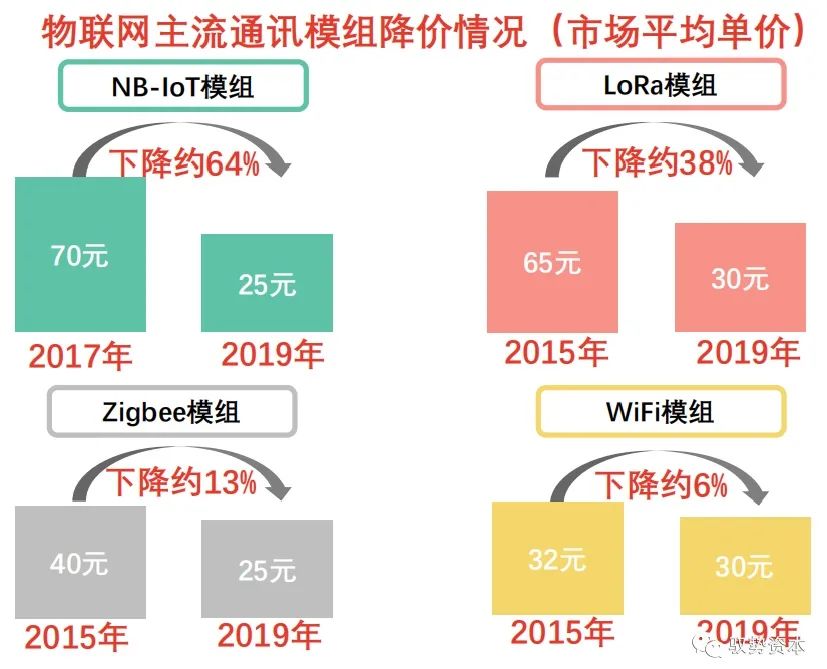
Against the backdrop of slowing development in the traditional consumer electronics terminal market, WiFi technology is gradually shifting its target application markets and is focusing on penetrating IoT application scenarios. In IoT application scenarios, WiFi technology faces competition from wireless transmission technologies such as NB-IoT, LoRa, and Zigbee. Compared with technologies such as NB-IoT and LoRa, WiFi technology is at a disadvantage in terms of power consumption and the number of connected devices. In addition, the price decline of WiFi modules is smaller than that of modules using other technologies, which is not conducive to further application and promotion of WiFi in the IoT field.
Analysis of policies and regulations related to China's WiFi industry
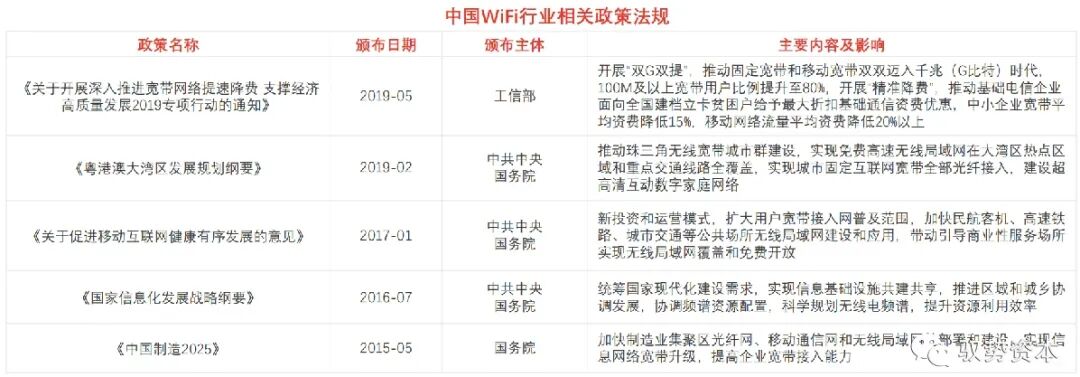
Several important industrial plans issued by the Chinese government have put forward relevant development requirements and guidelines for wireless communications and wireless local area network technologies, effectively promoting the further development of the WiFi industry.
In July 2016, the Central Committee of the Communist Party of China and the State Council issued the National Informatization Development Strategy Outline, proposing to coordinate the needs of national modernization, realize co-construction and sharing of information infrastructure, coordinate spectrum resource allocation, scientifically plan radio spectrum, and improve resource utilization efficiency. This policy is conducive to the standardized allocation of China's spectrum resources and enables WiFi technology to operate in a stable spectrum environment. In February 2019, the Central Committee of the Communist Party of China and the State Council issued the Outline Development Plan for the Guangdong-Hong Kong-Macao Greater Bay Area, proposing to promote the construction of wireless broadband city clusters in the Pearl River Delta, achieve full coverage of free high-speed wireless local area networks in hotspot areas and key transportation routes in the Greater Bay Area, and realize all-optical access for urban fixed Internet broadband. As one of the important wireless local area network technologies, WiFi will be gradually promoted and applied in the Guangdong-Hong Kong-Macao Greater Bay Area.
Development trends of China's WiFi industry
WiFi 6 will form a complementary and coexisting relationship with 5G technology
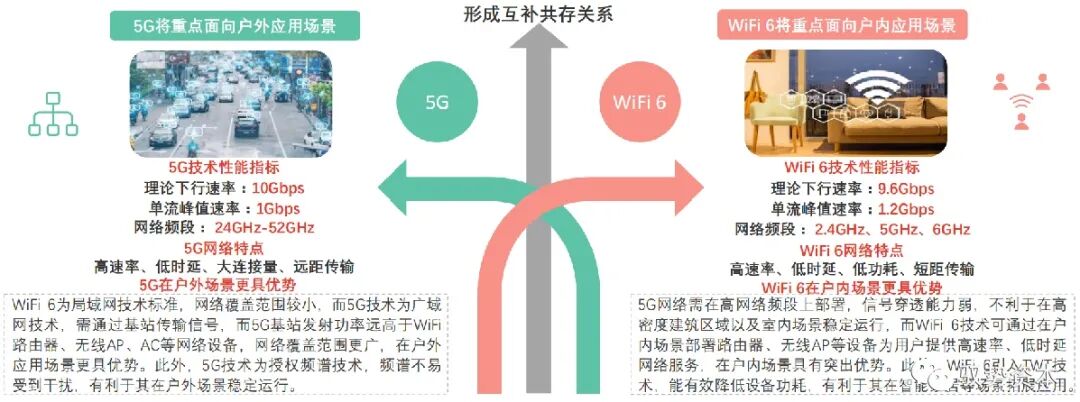
Both 5G and WiFi 6 apply MIMO-related technologies and share outstanding advantages such as high speed and low latency, but their technical essences and application advantages are different. 5G will focus on outdoor scenarios, while WiFi 6 will focus on indoor scenarios.
5G and WiFi 6 are two cutting-edge technologies in the communications field. Both technologies have advantages such as high speed and low latency and can be applied to application areas such as the Internet of Things, virtual reality, and ultra-high-definition video. From the perspective of the essential characteristics of the two technologies, 5G is a wide area network licensed spectrum technology focused on outdoor application scenarios, while WiFi 6 is a local area network unlicensed spectrum technology focused on indoor application scenarios. Their application advantages differ. WiFi 6 can improve the poor penetration, low coverage, and high power consumption of 5G communications in indoor scenarios, while 5G can improve the problem that WiFi 6 cannot achieve long-distance transmission of a large number of devices in outdoor scenarios. The two will gradually form a complementary and coexisting relationship.
Emerging application scenarios continue to increase
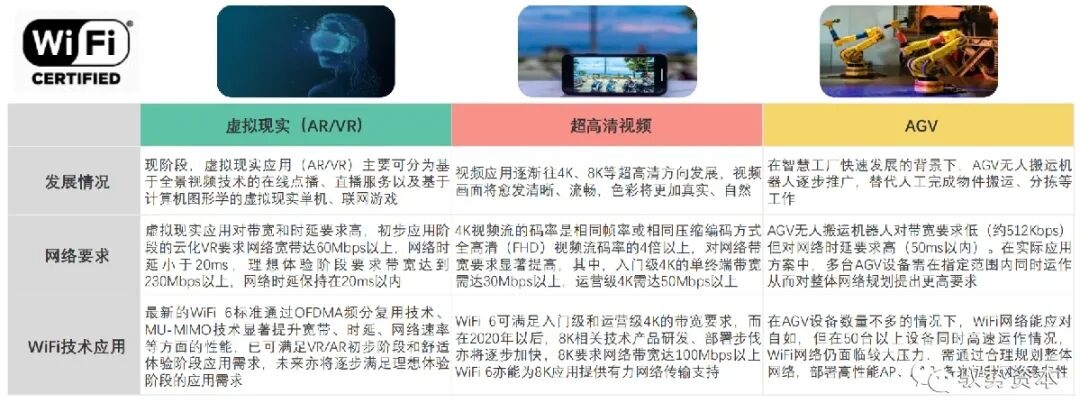
With the gradual application and promotion of the WiFi 6 standard, the performance advantages of WiFi networks, such as high speed, low latency, and low power consumption, will become more prominent, and emerging application scenarios using WiFi networks will continue to increase.
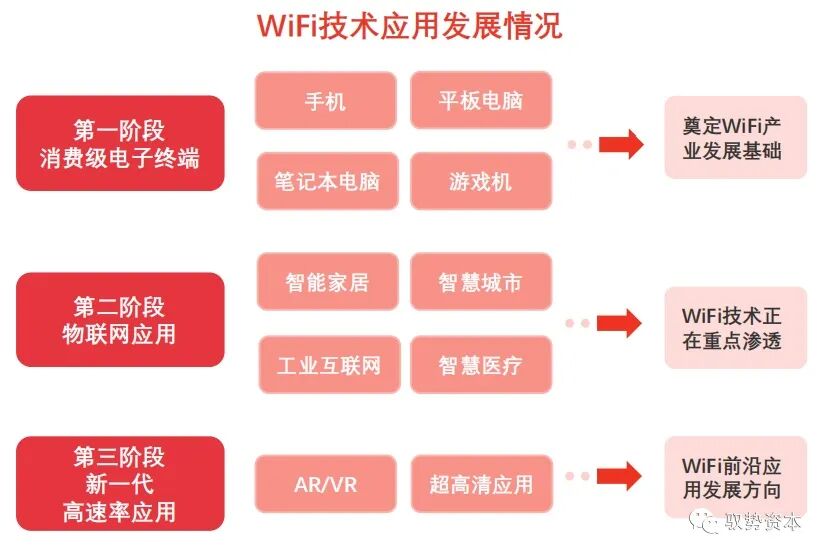
Compared with previous-generation WiFi technology standards such as WiFi 4 and WiFi 5, WiFi 6 improves bandwidth, network speed, network latency, power consumption, and other aspects, thereby further expanding WiFi technology application scenarios. From the perspective of the application development of WiFi technology, the first stage was driven by consumer electronic terminals such as mobile phones, tablet computers, and notebook computers; the second stage was driven by IoT applications such as smart homes and smart cities; and the third stage is driven by new-generation high-speed applications such as virtual reality and ultra-high-definition video applications. Driven by the development of the WiFi 6 technical standard, the pace of WiFi technology advancing toward the third stage is accelerating.
Competitive landscape of China's WiFi industry market
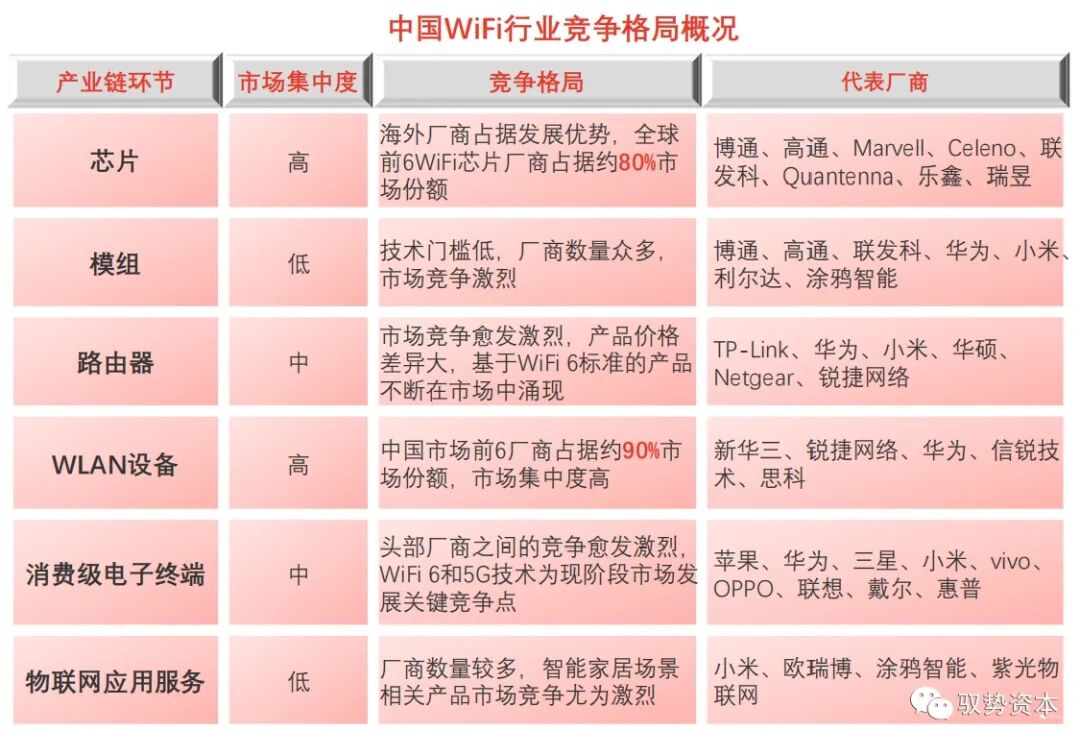
There is still a large gap between the development level of Chinese WiFi chip manufacturers and leading overseas manufacturers, and further improvement is still needed. WiFi 6 is a key competitive point for industry development at the current stage, and WiFi 6-related network equipment and terminal equipment products will continue to increase.
Chinese manufacturers have the lowest participation in the WiFi chip segment: The WiFi chip market is highly concentrated and dominated by overseas manufacturers, and Chinese manufacturers have the lowest participation in the WiFi chip segment. Among Chinese chip manufacturers, Espressif Systems has gradually accumulated advantages in WiFi MCU chips, and Huawei applies its self-developed Lingxiao series chips in its newly released AX3 WiFi router. The development pace of Chinese manufacturers is accelerating, but there is still a large gap compared with leading overseas manufacturers.
WiFi 6 is a key competitive point for industry development at the current stage: Manufacturers in all segments of the WiFi industry chain are successively developing products supporting the WiFi 6 standard, and WiFi 6 is a key competitive point for industry development at the current stage. Over the past two years, WLAN equipment, routers, and mobile phone terminal products supporting the WiFi 6 standard have attracted great market attention, and manufacturers leading in WiFi 6-related products include Huawei, Xiaomi, Ruijie Networks, and others. Huawei has laid out WiFi 6-related products in routers, WLAN equipment, mobile phone terminals, and other areas, among which the AirEngine series WLAN equipment has developed most prominently. Xiaomi is at the forefront in WiFi 6 routers, mobile phone terminals, smart home devices, and other areas.
*Disclaimer: This article is originally written by the author. The content of the article represents the author's personal views. Taixin Semiconductor reposts it only to convey a different viewpoint and does not mean that Taixin Semiconductor agrees with or supports such views. If there are any objections, please feel free to contact Taixin Semiconductor.

Zhuhai Taixin Semiconductor Co., Ltd.
Zhuhai Taixin Semiconductor Co., Ltd. was founded in 2016 and is a high-tech enterprise integrating integrated circuit design and wireless intelligent communication solutions. We have successively launched long-distance, low-power IoT WiFi chips, low-power motor controller chips, and product solutions. The company adheres to a market-oriented and technology-centered approach and provides customers with high-quality chips and product technical solutions.
The company's core product: WiFi communication chips for long-distance, low-power IoT. The chips can be used in product fields such as smart homes, security monitoring, drone image transmission, smart meter reading, smart door locks, smart grids, smart hospitals, and logistics robots.