Taixin Semiconductor

News detail

Ultra-long-distance stable transmission: HaLowMesh extends the network farther

Wi-Fi HaLowTMA single device

can cover about 1.5 kilometers

However, in practical applications

sites such as factory areas, dams, and farmland

often stretch for several kilometers

the coverage range of a single device

cannot fully cover them all

In such scenarios, further increasing the transmission distance of a single device is not the main approach. A more effective method is relay networking with multiple devices: add intermediate nodes along the signal path to receive and forward signals, and the coverage extends outward with the number of hops. This is Mesh networking.

Mesh is often simply understood as "adding a few more nodes." The number of nodes and the distance of each hop together determine the coverage of the entire network. However, increasing the number of nodes brings adverse effects such as increased latency and reduced bandwidth. Therefore, by comparison, the transmission distance of each hop is the more critical determining factor.

How far can each hop transmit?

In the 2.4GHz and 5GHz bands, each hop of a Mesh network is usually planned at tens of meters. After the signal passes through two load-bearing walls, the transmission distance drops sharply. To cover a one-kilometer range, more than ten devices often need to be deployed; each data forwarding incurs losses in rate and latency, and if any intermediate device is blocked, all downstream nodes are affected.

TXW8301 adopts a lower operating frequency band. The chip operates from 730MHz to 950MHz, with a longer wavelength and better diffraction and penetration capabilities than the 2.4GHz and 5GHz bands. The chip supports frequency-hopping communication, enhancing anti-interference performance. With +20dBm transmit power and 2/4/8MHz bandwidth configurations, the single-hop transmission distance is about 1.5 kilometers.

Actual deployment environments are not so ideal. Corners, metal shelves, multiple floors, and rows of equipment and vehicles all shorten the effective distance, so margins need to be reserved during network planning. Even so, for the same two-hop link, the coverage range of 2.4GHz and 5GHz is about more than 100 meters, while Wi-Fi HaLowTM+Mesh can easily reach more than two kilometers. Through multi-hop relaying, the coverage distance can be extended several times.

Based on a conservative estimate of 1 kilometer per hop, a 5-hop relay can achieve a coverage diameter of up to 10 kilometers. For sites such as factory areas, dams, and contiguous farmland that stretch for ten kilometers, a single network can easily provide coverage.

HaLowMesh networking approach

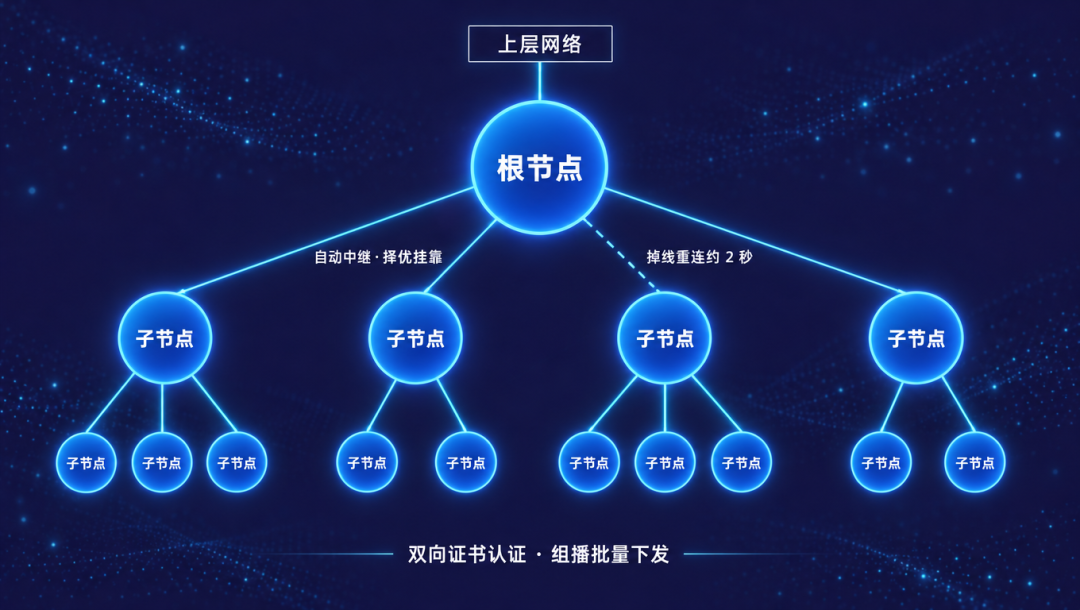
Wi-Fi HaLowTM+Mesh This networking capability is called HaLowMesh and is provided directly by the TXW8301 chip and module. In the network, one device acts as the root node and is responsible for connecting to the upper-layer network; the remaining devices act as child nodes. After power-on, they automatically search for available nodes to join the network, with no need to configure network parameters or set up each device individually.

After a node joins the network, automatic relaying comes into play. When a new node joins, it automatically selects the surrounding node with the best signal quality to attach to; once attached, that node also provides network access services to surrounding devices, allowing the network to expand outward layer by layer.

When a parent node goes offline, child nodes reselect their transmission path. A node that is transmitting service data can complete the switch in about two seconds; a node with no active service must wait for a timeout before switching, which takes longer. Therefore, in network planning, nodes at key points should remain in a communicating state to ensure reliable switching speed.

The security mechanism uses mutual certificate authentication: nodes and the root node verify each other's identity, and all communications are encrypted throughout. For networks such as electricity meters and power grid control, device access must have admission control, making the security layer indispensable.

After devices form a network, data that needs to be delivered in batches, such as firmware upgrades and broadcast control, is transmitted via multicast and does not need to be sent to each device individually.

Mesh has two topology forms: one is a master-slave structure with a tree topology; the other is a peer-to-peer structure in which nodes can forward data to one another. HaLowMesh belongs to the former, so the required topology form should be confirmed first during solution design.

The chip has a complete set of interfaces, and relay nodes can be configured in bridge mode to connect directly to an existing network, without modifying the existing network architecture for networking.

Number of attached devices, transmission rate, and power consumption
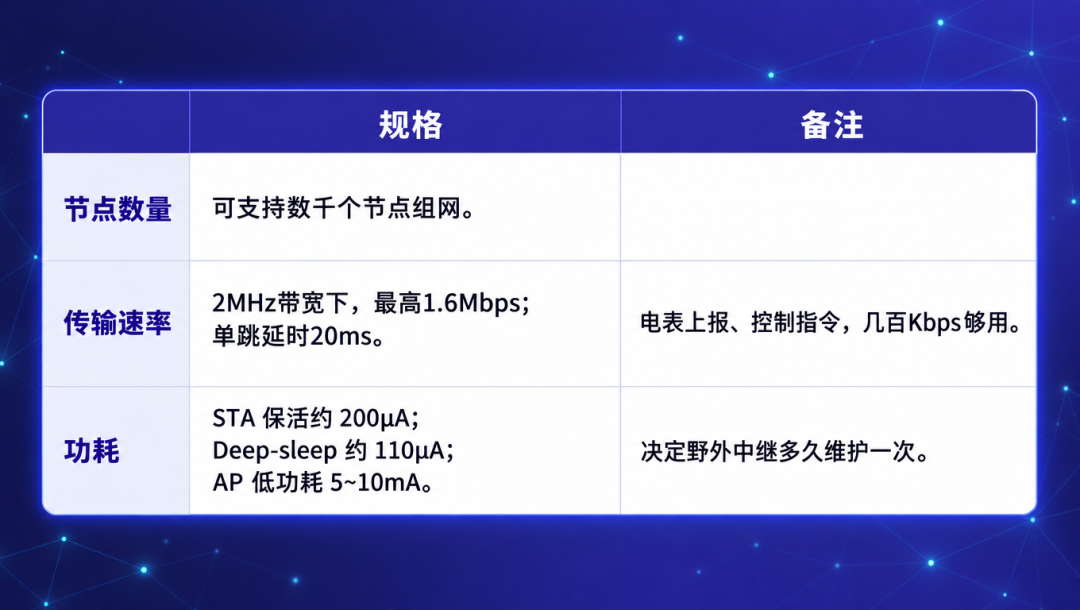
In terms of node count, thousands of nodes can be networked. In actual deployment, how many devices a single node can attach is determined by firmware configuration; network planning should be calculated based on the attached device count.

Transmission rate must be judged according to the network type. HaLowMesh targets application scenarios with many nodes and small data volumes. At 2MHz bandwidth, the transmission rate is up to 1.6Mbps with aggregation enabled and 320Kbps with aggregation disabled, with a single-hop latency of 20ms, corresponding to a coverage range of about 1.5 km per hop. For services such as periodic meter reporting and power grid control commands, this rate can easily meet the requirements.

Take the centralized meter reading of a community with 3,000 households as an example. After adopting HaLowMesh networking, meter reading for the entire community can be completed within 30 minutes, a sharp reduction compared with the 3 hours required by traditional solutions.

Power consumption ultimately affects O&M costs. Relay nodes deployed in the field usually rely on battery or solar power, and power consumption data directly determines the frequency of on-site maintenance. The fewer relay nodes deployed, the smaller the maintenance workload.

Not all scenarios require Mesh networking. Links such as bridging between adjacent floors, across the diagonal of a warehouse, or from a courtyard gate to the main house can be satisfied with a single hop; forcibly adding nodes only increases potential failure points.

HaLowMesh is suited to another type of network: many devices, small data volume per point, and dispersed distribution. Typical examples include electricity meters, power grid control, and industrial IoT, with hundreds of nodes, each transmitting a limited amount of data per day; the core requirement is that all nodes stay online and can recover automatically after disconnection. Long, narrow sites such as cross-building campuses, dam galleries, and agricultural plots also fall into the applicable scenarios, since obstructions are difficult to solve even with elevated antennas.

All capabilities are integrated on a single chip, providing a link that can be used directly without building from scratch.

Let connections reach farther

This is the direction we continue to invest in

For selection advice or evaluation board and sample support

please leave a message in the WeChat official account backend

Contact Us

Zhuhai Taixin Semiconductor Co., Ltd. was founded in November 2016. It is a national-level specialized and innovative 'Key Little Giant' enterprise focused on chip design in the AIoT field, and has been listed on the 'China IC Unicorn' list. With outstanding technical strength, the company's products have won the prestigious 'China Chip' industry honor three times.

The company has deep expertise in core technologies for wireless communication and audio/video processing, and possesses full-stack independent R&D capabilities in baseband, protocol stacks, and RF circuits. As one of the first companies in the world to achieve Wi-Fi HaLowTMchip mass production, Taixin has established a first-mover advantage in the long-distance IoT field with ultra-strong penetration and ultra-low power consumption; at the same time, the company was among the first to launch audio/video SoC chips integrating SparkLink technology, fully empowering cutting-edge audio/video scenarios such as AI glasses, high-definition drone image transmission, and video doorbells with low latency and strong anti-interference performance.

In terms of technology layout, the company has made a forward-looking layout in LTE Cat.1 chips, further improving its mid-rate IoT technology landscape and successfully building a dual-technology-driven system of 'wireless + cellular.' Its product matrix fully covers ultra-long-range, low-power, multi-protocol integration, and complex industrial-grade scenarios, broadly empowering diverse fields such as consumer electronics, security surveillance, smart home, embodied robots, Internet of Vehicles, and industrial Internet, and has been recognized by many leading customers including Hikvision with large-scale shipments.

As an active promoter of the industry ecosystem, Taixin Semiconductor is a full member of the Wi-Fi Alliance, SparkLink Alliance, Wi-Sun Alliance, and RISC-V Alliance. In the future, the company will continue to uphold its corporate culture of 'diligence, innovation, pragmatism, and growth,' and through continuous technological innovation and application expansion, provide global customers with high-performance, stable and reliable, and cost-effective one-stop AIoT chips and solutions, helping to drive the vigorous development of the era of ubiquitous intelligent connectivity.

Company Profile /Company Introduction