Taixin Semiconductor

News detail

Practical Sharing | Understanding the Differences Between dB, dBm, and dBw in 100 Minutes

中兴文档2021-05-08

dB should be the most basic and most familiar concept in wireless communications. We often say 'propagation loss is xx dB' and 'transmit power is xx dB

dB should be the most basic and most commonly used concept in wireless communications. We often say 'propagation loss is xx dB,' 'transmit power is xx dBm,' and 'antenna gain is xx dBi'...
 
Sometimes, these similarly named dBx values may be confused, or even cause calculation errors. What exactly are the differences between them?
 
This has to start withdBfirst.
 
And when it comes to dB, the most common one is3 dB!
3 dB often appears in power diagrams or bit error rate diagrams. Actually, there is nothing mysterious about it: a drop of 3 dB means the power drops by half, and the 3 dB point refers to the half-power point. 
+3 dBindicates an increase to twice the value,-3 dBindicates a decrease to1/2.How does this come about?
 
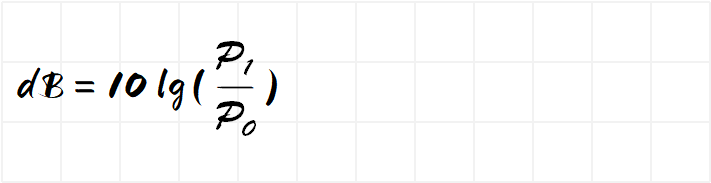
Actually, it is very simple. Let us take a look at the formula for calculating dB:
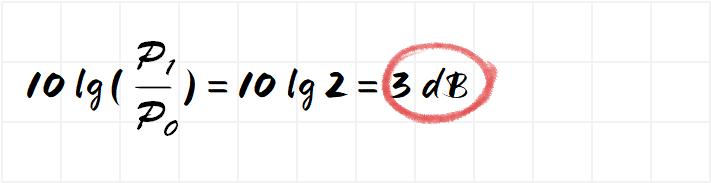
dB represents power P1relative to the reference power P0the magnitude relationship. If P1is P0twice, then: 
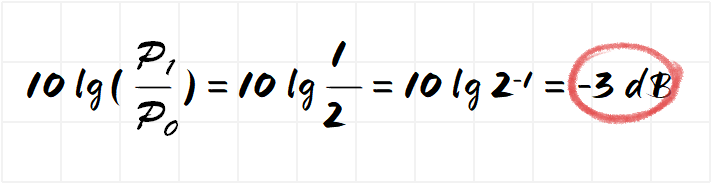
If P1is P0half, then: 
 
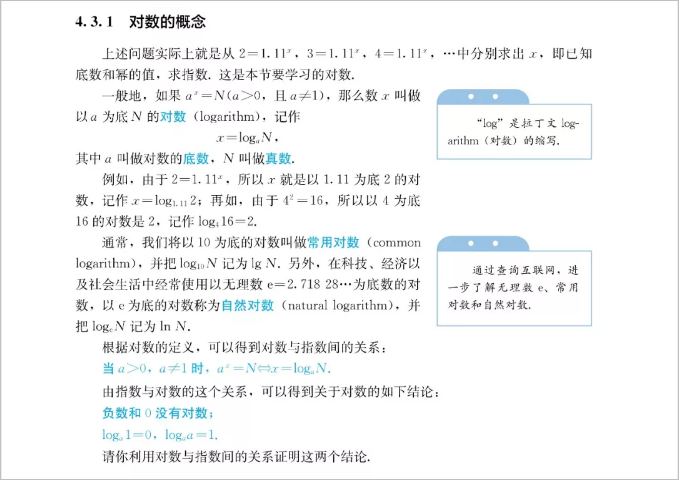
For the basic concepts and operational properties of logarithms, you can review first-year high school mathematics on your own... 
 
Now here's a question to test your understanding:
[Question] Power increases to 10 times; expressed in ? dB
 

Click the blank area below to view the answer

▼
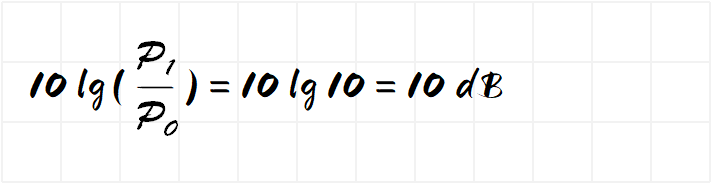
Here, please remember a mnemonic.Once you remember this mnemonic, you can basically walk around like a boss. 
+3 dB means power increases by a factor of 2;+10 dB means power increases by a factor of 10.
-3 dB means power decreases to 1/2; -10 dB means power decreases to 1/10.
 
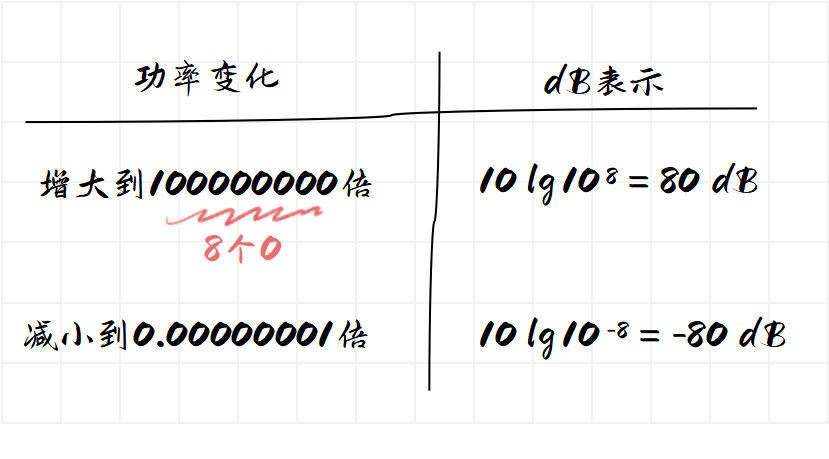
It can be seen that dB is a relative value; its mission is to express a very large or very small number in a brief form. 
This can greatly facilitate our calculations and descriptions. Especially when drawing tables, you can imagine it for yourselves: before conversion to dB, with so many zeros, the axis would have to be stretched all the way into outer space...

If you understand dB, you can only walk sideways; if you understand the other members of the dB family, you can win effortlessly. 
Let's start with the most commonly used dBm and dBw.
 
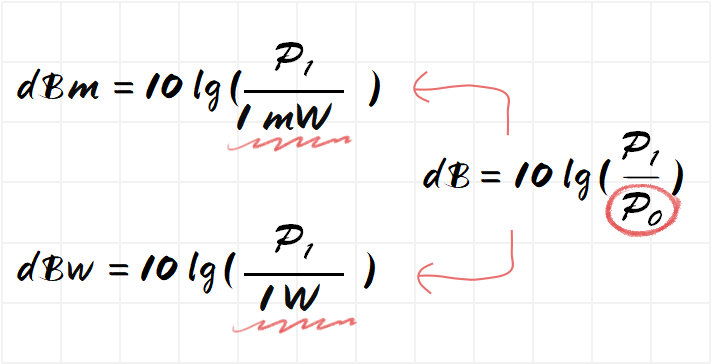
dBm and dBW are obtained by replacing the reference power P0with 1 mW and 1 W, respectively: 
 
Both 1 mW and 1 W are fixed values, so dBm and dBW can both represent absolute power values.
Here is a power conversion table for reference.

watt

dBm

dBW

0.1 pW
-100 dBm
-130 dBW
1 pW
-90 dBm
-120 dBW
10 pW
-80 dBm
-110 dBW
100 pW
-70 dBm
-100 dBW
1 nW
-60 dBm
-90 dBW
10 nW
-50 dBm
-80 dBW
100 nW
-40 dBm
-70 dBW
1 μW
-30 dBm
-60 dBW
10 μW
-20 dBm
-50 dBW
100 μW
-10 dBm
-40 dBW
794 μW
-1 dBm
-31 dBW
1.000 mW
0 dBm
-30 dBW
1.259 mW
1 dBm
-29 dBW
10 mW
10 dBm
-20 dBW
100 mW
20 dBm
-10 dBW
1 W
30 dBm
0 dBW
10 W
40 dBm
10 dBW
100 W
50 dBm
20 dBW
1 kW
60 dBm
30 dBW
10 kW
70 dBm
40 dBW
100 kW
80 dBm
50 dBW
1 MW
90 dBm
60 dBW
10 MW
100 dBm
70 dBW
 
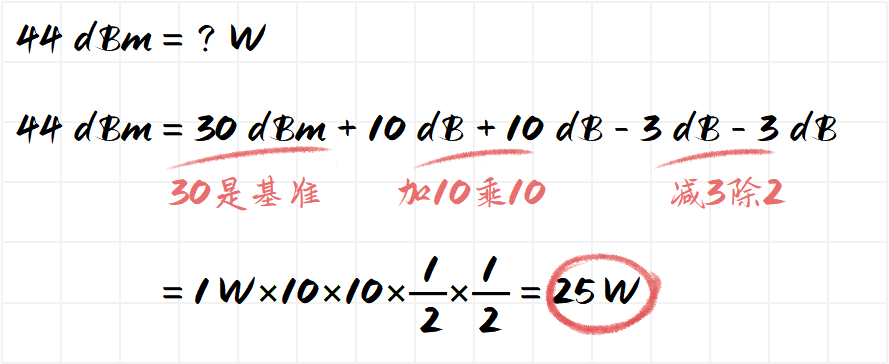
Here, we need to remember:
1 W = 30 dBm.
The simplified mnemonic is "30 is the benchmark, equal to exactly 1 W".
Once you remember this, and combine it with the earlier "add 3 and multiply by 2; add 10 and multiply by 10; subtract 3 and divide by 2; subtract 10 and divide by 10", you can perform many mental calculations. 
 
Let's quickly try a question to test it.
[Question] 44 dBm = ? W
 

Click the blank area below to view the answer

▼

Did you get it right?
 
Here we need to note that, on the right side of the equation, except for 30 dBm, all other decomposed terms must be expressed in dB. That is, when one dBx is subtracted from another dBx, the result is expressed in dB.
[Example] If A's power is 46 dBm and B's power is 40 dBm, it can be said that A is 6 dB greater than B.
[Example] If antenna A is 12 dBd and antenna B is 14 dBd, it can be said that A is 2 dB less than B.
 
 
For example, 46 dB indicates P1is P040,000 times, while 46 dBm indicates P1has a value of 40 W. The symbols differ only by an m, but their meanings can be completely different.

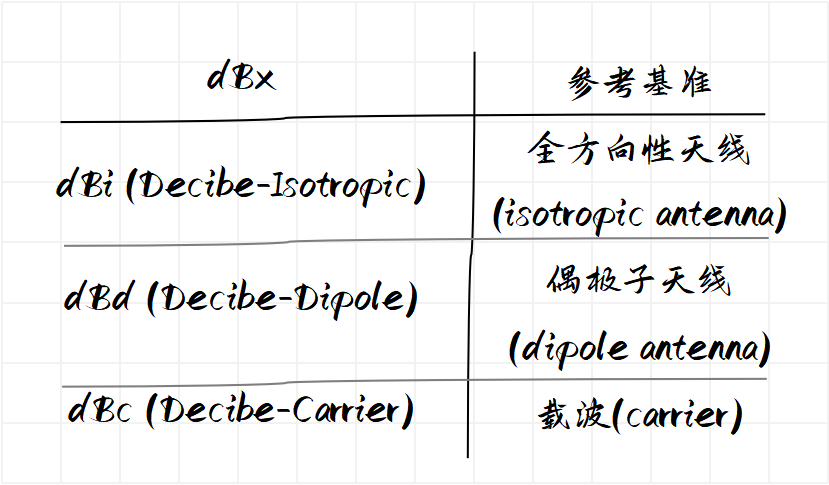
Common members of the dB family also include dBi, dBd, and dBc.Their calculation methods are exactly the same as those for dB, and they still represent relative power values.
The difference is that their reference bases are different; that is, the reference power P in the denominator0represents a different meaning.
It is generally believed that for the same gain, the value expressed in dBi is 2.15 larger than that expressed in dBd. This difference is caused by the different directivities of the two antennas, so we will not discuss it further here.
 

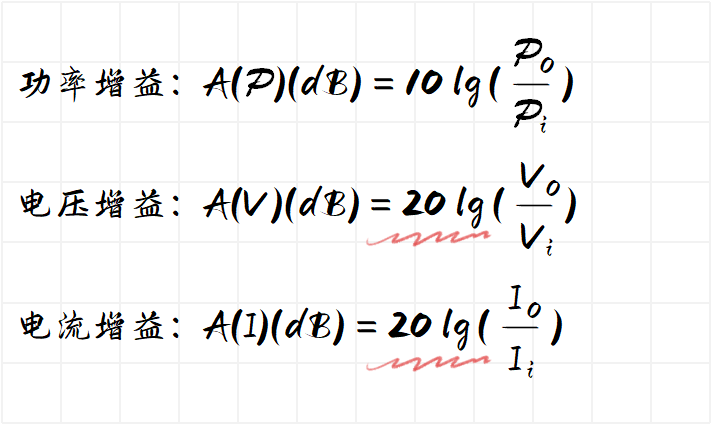
In addition, the dB family can represent not only power gain and loss, but also voltage, current, audio, etc.; it should be applied according to the specific scenario.
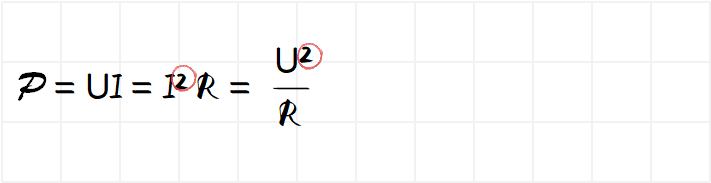
It should be noted that for power gain, we use 10lg(Po/Pi), for voltage and current gain, use 20lg(Vo/Vi), 20lg(Io/Ii). 
 
Where does this extra factor of 2 come from?
This 2 comes from the square in the electrical power conversion formula. The n-th power inside the logarithm corresponds to n times after calculation. 
 
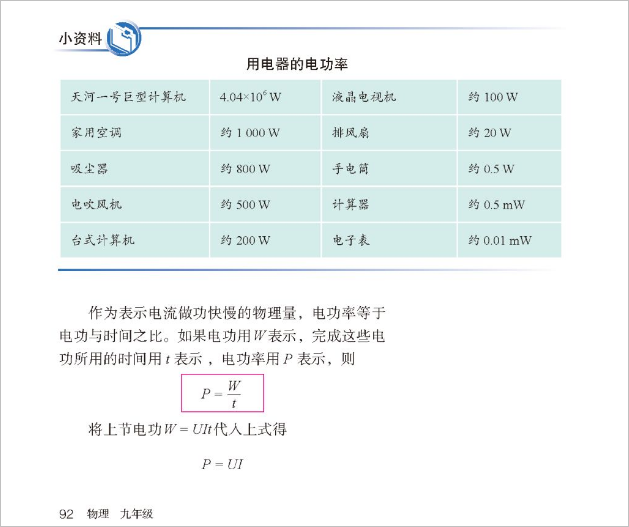
As for the conversion relationship between power, voltage, and current, you can review junior high school physics on your own...
 
 
Finally, the editor has compiled some main members of the dB family for your reference.
 
Relative value:
Symbol
Full name
Reference
dB
decibel
-
dBc
decibel carrier
Carrier power
dBd
decibel dipole
Dipole power density
dBi
decibel isotropic
Isotropic antenna power density
dBFS
decibel full scale
Full-scale value
dBrn
decibel reference noise
 Reference noise
 
 
Absolute value:
Symbol
Full name
Reference base
dBm
decibel milliwatt
1mW
dBW
decibel watt
1W
dBμV
decibel microvolt
1μVRMS
dBmV
decibel millivolt
1mVRMS
dBV
decibel volt
1VRMS
dBu
decibel unloaded
0.775VRMS
dBμA
decibel microampere
1μA
dBmA
decibel milliampere
1mA
dBohm
decibel ohms
1Ω
dBHz
decibel hertz
1Hz
dBSPL
decibel sound pressure level
20μPa
 
 
Finally, let's do two more questions to check everyone's results.
 
1. The power of 30 dBm is ( )
A. 1 W
B. 10 W
C. 1 mW
D. 10 mW

Click the blank area below to view the answer

▼
A 

This is a giveaway question~ Remember the mnemonic: 30 is the reference and equals exactly 1 W.

2. Assume the total cell output power is 46 dBm. With 2 antennas, the per-antenna power is ( )
A. 46 dBm
B. 43 dBm
C. 23 dBm
D. 40 dBm

Click the blank area below to view the answer

▼

「B」 

Remember the mnemonic "minus 3, divide by 2": with two antennas it is 46 dBm; with a single antenna, the power is reduced by half, which is minus 3 dB: 46 dBm -3 dB=43 dBm.

Or, you can alsoFirst calculate that 46 dBm corresponds to 40W; then the single-antenna power is 20W, that is, 10lg(20W/1mW)=43 dBm.

Alright, that is all for today's article. Tell us, did you make it to 100 minutes?
Note: This article is reprinted from ZTE Documentation, and the purpose of reposting thisarticle is to convey more information; the copyright belongs to the original author.

Zhuhai Taixin Semiconductor Co., Ltd.

Zhuhai Taixin Semiconductor Co., Ltd. was founded in 2016 and is a high-tech enterprise integrating IC design and wireless intelligent communication solutions. We have successively launched long-range low-power IoT WIFI chips, low-power motor controller chips, and product solutions. The company adheres to being market-oriented and technology-centered, and provides customers with high-quality chips and product technical solutions.

Core products of the company: WIFI communication chips for long-range low-power IoT. The chip can be used in smart homes, security monitoring, UAV video transmission, smart meter reading, smart door locks, smart grids, smart hospitals, logistics robots, and other product fields.